|
A ser traducido a la mayor brevedad.
Gracias, Alfredo Cecchini.
Career (Argentina)
Name: Libertad
Owner: Argentine Navy
Ordered:13 November 1953 (from a 1946
project)
Builder: Río Santiago Shipyard, Buenos
Aires Province, Argentina
Laid down:11 December 1953 Launched: 30
May 1956
Commissioned: 28 May 1963
Status: Commissioned, in active service
General characteristics
Type: Steel hulled, full-rigged class
"A" tall ship
Displacement:3,765 metric tonnes
Length:103.75 m (340.4 ft) (hull 91.7
meters)
Beam: 14.31 m (46.9 ft)
Draft:6.60 m (21.7 ft)
Propulsion: Pre mlu: 2 × Sulzer diesel
engines Post mlu: 2 × MAN diesel engines
B&W mod. 6L23/30-D, each with 6 inline
cylinders and 960 kW at 900 rpm
Speed: Pre mlu: 13.5 knots (25.0 km/h)
Post mlu: 13.73 knots (25.43 km/h)
Range: 12,000 nautical miles (22,000 km)
at 8 knots (15 km/h)
Complement: 24 officers, 187 crewmen, as
well as 150 cadets
Armament: 4 47 mm QF 3 pounder Hotchkiss
cannons
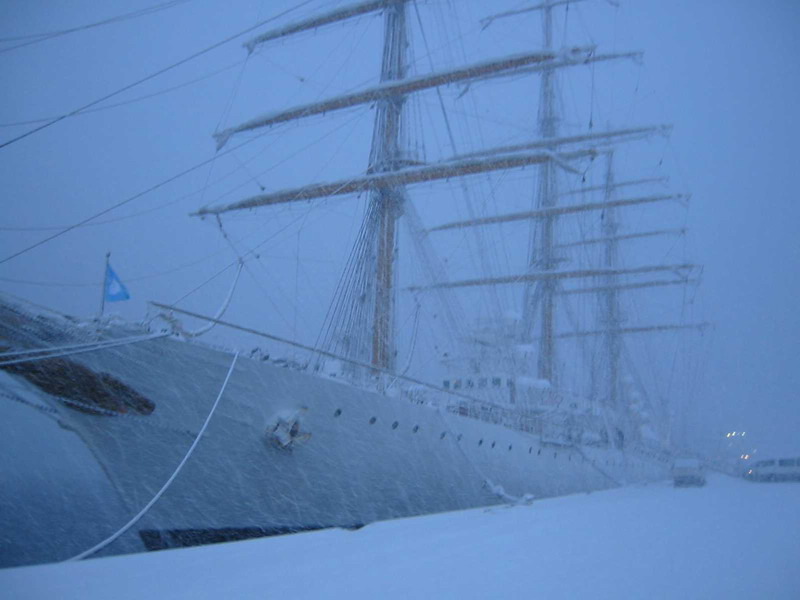
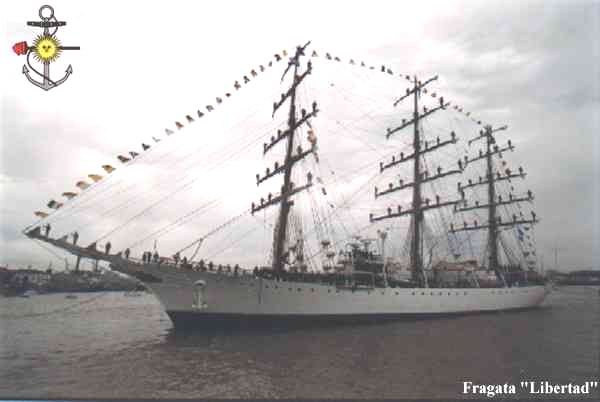
ARA Libertad (Q-2) is a steel hulled,
full rigged, class "A" sailing ship that
serves as a school vessel in the
Argentine Navy. One of the largest and
fastest tall ships in the world, holder
of several speed records, she was
designed and built in the 1950s by the
Río Santiago Shipyard, Ensenada,
Argentina. Her maiden voyage was in
1961, and she continues to be a training
ship with yearly instruction trips for
the graduating naval cadets as well as a
traveling goodwill ambassador, having
covered more than 800,000 nautical miles
(1,500,000 km) across all seas, visited
about 500 ports in more than 60
countries,[11] and trained more than
11,000 navy graduates.
Specifications
The ninth Argentine Navy vessel to bear
the name Libertad, she has a total
length (including bowsprit) of 103.75 m;
a beam of 14.31 m; a draft of 6.60 m;
and a displacement of 3,765 metric
tonnes: these figures place ARA Libertad
as the world's sixth longest tall ship
and the third heaviest in displacement.
Her complement is 357, including 24
officers, 187 crewmen and 150 naval
cadets, among them an ever increasing
number of invited officers from friendly
nations' armed forces, personnel from
the Argentine Army, Air Force and Coast
Guard, students, journalists and
distinguished people from different
areas and disciplines, both local and
foreign.
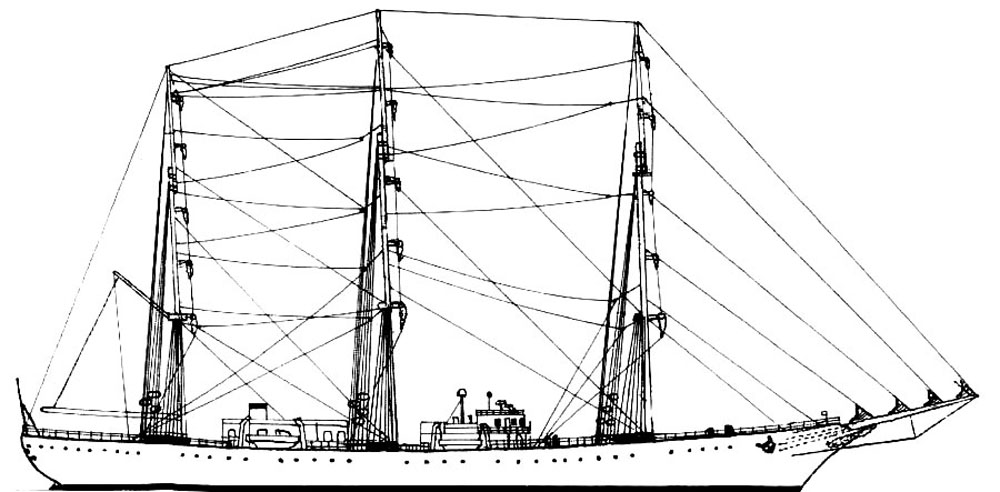
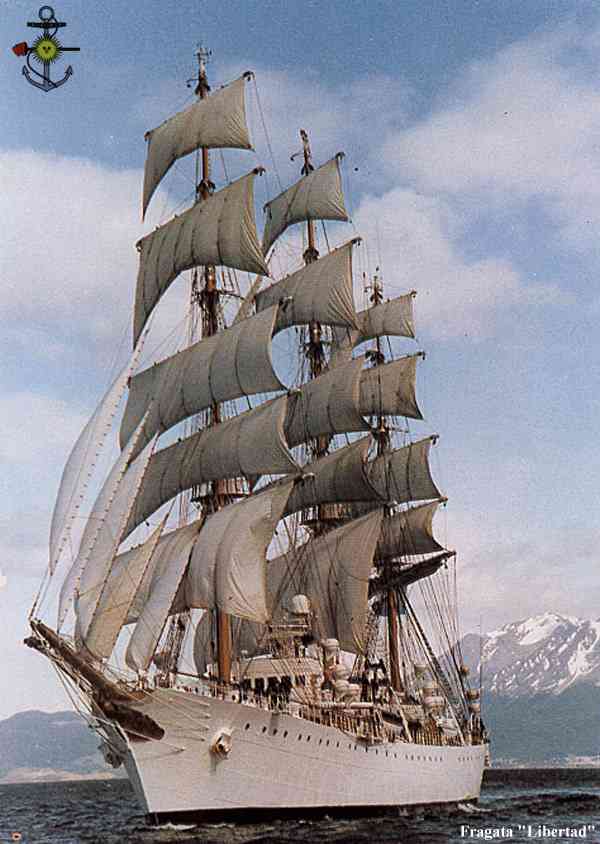
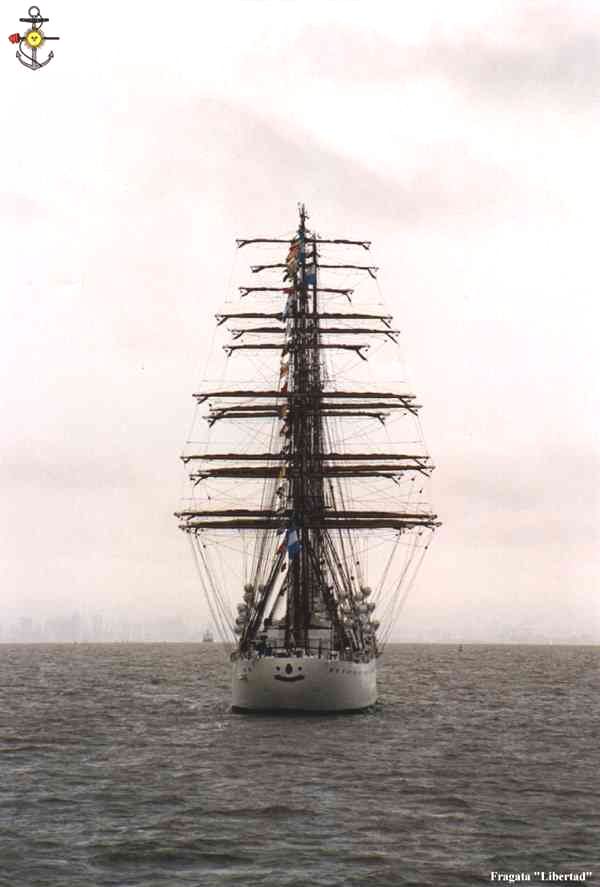
The ship's follows the archetypal
windjammer design, with a clipper bow
and a wood-carved figurehead
representing Liberty in a long flowing
robe and a cruiser stern bearing the
Argentine coat of arms in cast bronze.
She is an all square rigged vessel, with
bowsprit and three steel masts –Fore,
Main (height of 56,2m), and Mizzen with
boom– with double topsails and five
yardarms each, which can rotate up to 45
degrees on each side. Five jibs are
fixed to the bowsprit. All masts have
five square sails, with the foremast and
mainmast having three staysails, and the
mizzen, a spanker, summing up 27 dacron
sails with a total sail area of 2,652
square meters. Masts have a circular
cross section, formed by welded steel
sheets between 9.5mm and 12mm thick.
The vessel carries four fully functional
47 mm QF 3 pounder Hotchkiss cannons,
1891 model, which were transferred from
the previous school ship ARA Presidente
Sarmiento.[citation needed] Although
only used as a protocolar salute battery,
these cannons make Libertad the second
most heavily armed tall ship in the
world.
History
Design, construction and commissioning
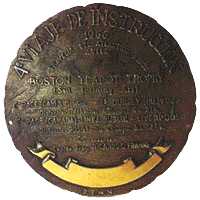
A bronze plaque reading "Built at Río
Santiago Shipyard - A.F.N.E. Argentine
Republic - Year 1962" (in Spanish) on
board ARA Libertad
Continuously since 1873 the Argentine
Navy had a number of commissioned school
ships in active service for training
future officers in seamanship skills. In
1938, after retirement of ARA Presidente
Sarmiento as seagoing academy vessel,
her role was temporarily undertaken by
the light cruiser ARA La Argentina. The
project for a definitive replacement
ship fully conceived and built by
Argentines started in 1946.
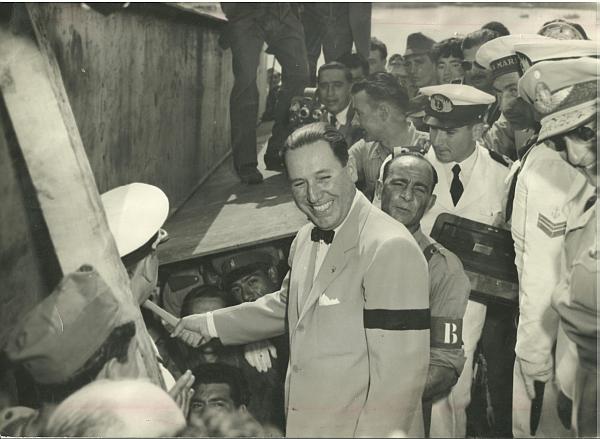
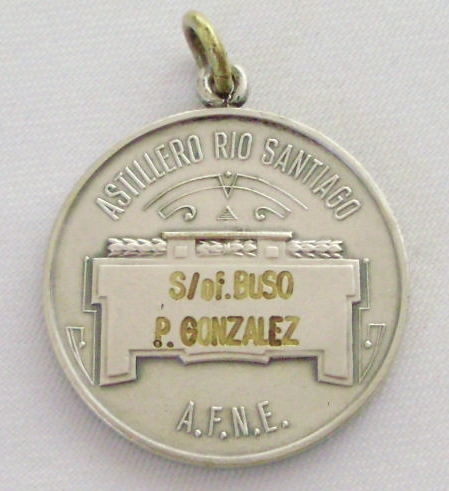
On 11 December 1953, during Juan Domingo
Perón's second term, the vessel's keel
was laid down at the Río Santiago
Shipyard, A.F.N.E. ("State Shipbuilding
and Naval Factories", itself a peronist
creation). Between 1954 and 1955 the
shipyard engineers included several
modifications to the vessel's original
design and configuration. During the de
facto government of the self called "Liberating
Revolution" the name "Libertad" was
imposed by decree number 7922 (April 27,
1956).
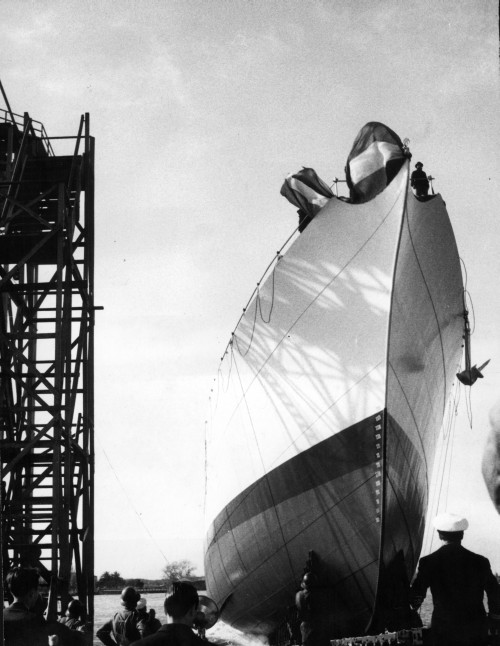
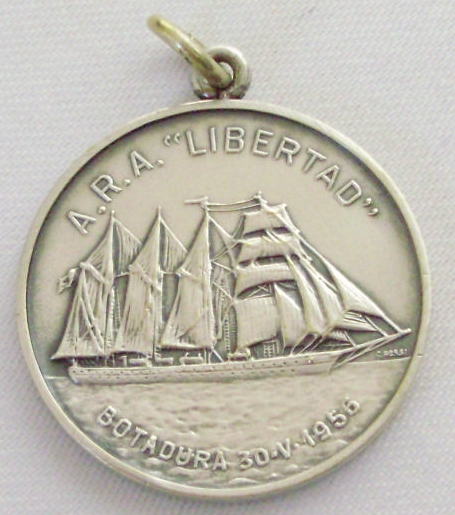
On 30 May 1956 she was launched to sea,
but her completion and commissioning
suffered the vicissitudes of that
Argentine period's unease political
situation. The sea trials began in March
1961 and were carried to term under the
command of Captain Atilio Porretti, who
ordered changes to the vessel's rigging
and figurehead. During this baptism
voyage the ship successfully rode out a
violent South Atlantic Ocean tempest. In
March 1962 she joined the Navy's
Instruction Division, formally starting
out as the country's school ship.[1] One
year later, on 28 May 1963, the finished
frigate was delivered to the Argentine
Navy and, with the ceremonial hoisting
of the Argentine Ensign, formally
commissioned to replace ARA La Argentina
as the Navy's school ship. On June 19,
and without her figurehead attached (still
being carved in wood by Galician-Argentine
sculptor Carlos García González), she
sailed from Buenos Aires on her first
training voyage in command of Captain
Horacio Ferrari, along with officers
Orlando Perez Cobo, Heinz Otto Grunewald,
and Lieutenant Commander Mario A.
Manfredi as public relations officer.
Trophies and notable voyages
In 1964 the frigate competed for the
first time in a major offshore race for
tall ships between the ports of Lisbon
and Hamilton, Bermuda. In 1965 she
completed her first round-the-world trip.
In 1966, during her fourth instruction
voyage, ARA Libertad won the Great Medal
Prize for establishing the tall ships'
world record for crossing the North
Atlantic Ocean using only sail
propulsion. She did so by running
between Cape Race (Canada) and the
imaginary line going from Dublin to
Liverpool –2,058.6 nautical miles
(3,812.5 km)– in 8 days and 12 hours, a
record that has not been beaten. During
the same trip, she also set the 124 hour
run record for a sail school ship at
1,335 nautical miles,[16] for which she
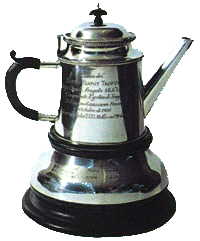
was awarded the Boston Beanpot Trophy.[8]
The captain was Commander Ricardo
Guillermo Franke, and the Boston Teapot
was presented by Prince Philip, Duke of
Edinburgh in name of Queen Elizabeth II.
Libertad has won the Boston Teapot
Trophy nine times in total: in 1966,
1976, 1981, 1985, 1987, 1992, 1998,
2000, and 2007.
In 1970 she was part of the "Parade of
Large Sailboats" in Sydney celebrating
the bicentenary of the first European
settlement in Australia.
The ship took part in the celebrations
of the United States Bicentennial on
July 4, 1976 by sailing in parade, with
many other tall ships from all over the
world, on the Hudson River, in front of
New York City, in what was called
Operation Sail. She also participated in
1964, 1986, 1992 and 2012. During 1976's
Operation Sail the Spanish ship Juan
Sebastián Elcano collided with Libertad
and with the full-rigged, three masted
Norwegian ship Christian Radich just off
the coast of Bermuda. The collision
snapped Elcano's foremast just above the
forecourse yardarm, forcing her to
abandon the race and return to New York
under engine power. Libertad suffered
only light damage (two torn sails,
smashed lifeboats and port rail) and,
like Christian Radich, continued in the
competition without problems.
In 1985 raced in "Sail Amsterdam" in the
Netherlands and in the celebrations for
the Statue of Liberty centenary in New
York. One year later Libertad sailed in
Bremerhaven in Germany. In 1989, among
many events, she was part of "Les Voiles
de la Liberte" for the bicentennial of
the French Revolution in the port of
Rouen, France.
In 1992 was part of the great Cadiz
regatta in commemoration of the 500
anniversary of Columbus' 1492 voyage. In
1997 she sailed in the international
race "Sail Osaka 97" in celebration of
the 100th anniversary of the port of
Osaka, Japan.
In 1998 Libertad won Americas' Sail tall
ship race between Savannah, Georgia and
Glen Cove, New York, United States.
In 1999 took part in the gathering of
tall ships "The Navy of the Century" in
France.
By presidential decree number 727 (May
30, 2001) the frigate was designated as
"Embassy of the Republic as a matter of
honorary distinction and with purely
protocolar effect".
On 2 October 2003, she caught fire while
anchored off the Spanish port of Ferrol
during that year's training trip. The
incident severely damaged the ship's
hull and bedrooms of aspiring
midshipmen, and five sailors were
hospitalized for smoke inhalation. Three
fire fighting squads brought the fire
under control after three hours.
Following this incident, between 2004
and 2006 the instructional trips were
made aboard the multipurpose ship ARA
Hercules.
ARA Libertad participated in Velas
Sudamerica 2010, an historical Latin
American tour by eleven tall ships to
celebrate the bicentennial of the first
national governments of Argentina and
Chile.
Mid-life update
In 2004 she underwent a general mid-life
update with special effort put into
security and comfort, seeking to extend
the vessel's lifespan for at least
another forty years.[5] The extensive
works were finished in April 2007 and
included:
• New integral painting
• Replacement of all Burma teak linings
• Modernization of steering gear
• Renewal of kitchens, laundry, nursing
and dental office equipment
• Upgrading of all light appliances
• Replacement of all ship's piping and
vents, using new materials and adapting
them to the new embedded systems
• Building foundations for the new
systems and equipment parts
•
The overhaul, performed at Río Santiago
Shipyard by more than 350 workers,
required 285 tonnes of metal for the
hull, decks and internal structures and
over 25 tonnes of different shaped steel
profiles.
Bedrooms and bathrooms were refitted to
allow the incorporation of female
midshipmen, corporals and sergeants, in
line with current diversity policies in
the Argentine Navy. The propulsion plant
was upgraded to two MAN B&W turbocharged
diesel engines mod. 6L23/30-D, each with
six inline cylinders and 960 kW at 900
rpm that improved performance to a
maximum speed of 13.73 knots and a
cruising speed of 12.5 knots (from
previous 13.5 and 8 knots respectively)
This modification included replacing the
propeller shaft.
The radar navigation system was replaced
by an advanced model that holds greater
scope and definition. The vessel update
also included changing all power,
communications, alarm, signalling and
monitoring cabling, an adaptation
required for the newly incorporated
systems. The rigging was fully upgraded,
which included bringing down, checking
and repairing the spars, and renewing
more than 55,000 meters of ropes,
shrouds, backstays and steel cables.
During the three years Libertad was
under overhaul, cadets sailed on the
Navy's corvettes ARA Rosales, ARA Spiro,
ARA Parker and on the Chilean Navy
school ship Esmeralda (BE-43)
Ghana incident
In early October 2012 the vessel was
impounded in the port of Tema, Ghana, by
a court ruling in favour of NML Capital,
a subsidiary of Cayman Islands hedge
fund Elliott Management Corporation,
which claimed that it was owed US$370m
(£233m) as a consequence of Argentina's
debt defaults of 2002, and was seeking
payment of $20m for release of the
vessel. NML was not originally a
creditor, but bought the debt for
"pennies on the dollar" according to
Forbes. Argentina's foreign ministry
condemned the move, claiming it as "a
stunt" pulled by "vulture funds, who are
not subject to the laws of any
jurisdiction".
On 25 October 2012 most of the ship's
crew returned to Argentina, leaving the
captain and 43 crew members with the
ship in Ghana.
On 15 December 2012 the UN International
Tribunal for the Law of the Sea ruled
unanimously that the ship had immunity
as a military vessel, and ordered that
"Ghana should forthwith and
unconditionally release the frigate ARA
Libertad", and report to the Tribunal on
compliance by 22 December.[31][38]
Libertad was released from Tema on 19
December. She arrived on 9 January 2013
to the port of Mar del Plata, where the
ship got an enthusiastic homecoming.[39]
Following the International Tribunal
ruling, the Ghana Ports and Harbours
Authority sued NML Capital for damages
of least US$7.6 million related to the
Libertad's impoundment. The Supreme
Court of Ghana ruled in June 2013 that
the 77-day impoundment was "unjustified,
and could have endangered the security
of Ghana by triggering a diplomatic
conflict."
Honors and decorations
• Medal of Honor to the Naval Merit
"Commander Pedro Campbell", awarded by
the Navy of Uruguay.
• Order of Naval Merit, awarded by the
Navy of the Dominican Republic.
• Order of Naval Merit Admiral Padilla,
awarded by the Navy of Colombia.
• Order of Rio Branco, awarded by the
Federative Republic of Brazil. |


-003%20%20x.JPG)