

"URUGUAY" 1952-1990
|
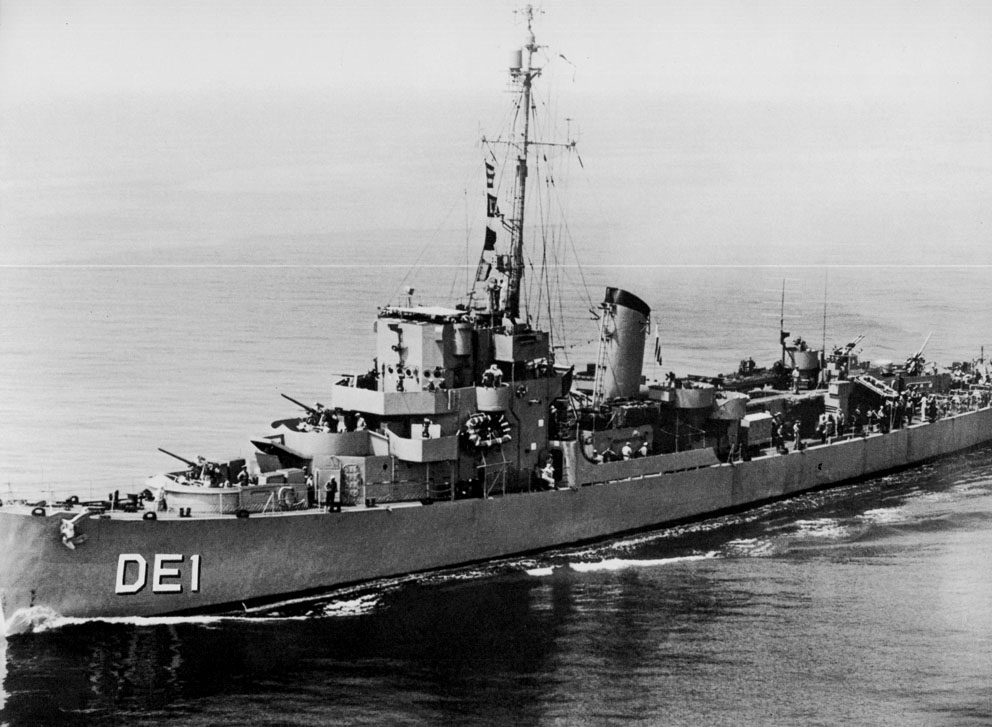
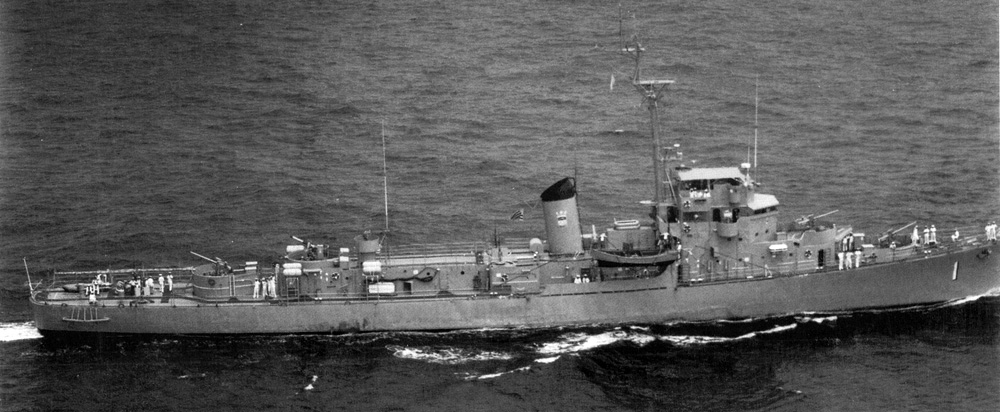
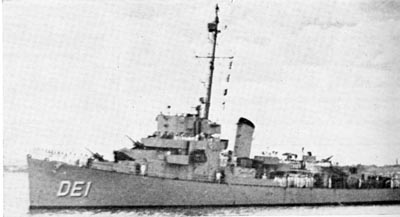
Sin lugar a dudas, la principal incorporación fueron los Destructores "Uruguay" y "Artigas", en 1952, los que permanecerían en servicio por cerca de cuatro décadas. La Segunda Guerra Mundial y sus consecuencias, determinaron la necesidad de instrumentar medidas defensivas contra la amenaza submarina cada vez más peligrosa. La formación de grandes convoyes de cargueros, escoltados por buques veloces y bien equipados con armamento antisubmarino, que se denominaron Destructores Escolta (DE), fue la mejor respuesta a aquella amenaza. Los DE 1 "Uruguay" y DE 2 "Artigas" marcaron un cambio sustantivo en la doctrina de la Armada Uruguaya, y el adiestramiento pasó a desempeñar un rol fundamental.
Estos dos destructores hicieron todo tipo de tareas, patrullaje maritimo, busqueda y rescate, operaciones internacionales, viajes de instruccion, traslado de autoridades, etc. Pero lo mas importante fue como escuela de la mayoria del personal superior y gran parte del personal subalterno de la armada. Ex USS Baron , Destroyer escort clase Cannon DE 166 Desplazamiento 1.240 toneladas - 1.900 totalmente cargado - Tripulacion 187 hombres (en condiciones de guerra) Medidas 306 x 36 x 14 pies. Maquinaria: Motores Diesel-electricos con dos ejes y 6.000 BHP para una velocidad de 21 nudos. Combustible fuel oil 300 tons., alcance 11.500 millas a 11 nudos. Armamento: Tres cañones de tres pulgadas, dos de 40 mm AA; 10 xe 20 mm AA. Tubois lanzatorpedos: tresde 21 pulgadas (triple). Antisubmarino: un hegdehog (puercosespín) y 8 lanzadores de cargas de profundidad. 2 generadores de humo. Desguazado en 1990.· |

|
From: Dictionary of American Naval Fighting Ships Baron Lieutenant Commander Richard S. Baron was killed 15 March 1942 during the bombing of Cebu City, Philippine Islands. Prior to his death, he had received the Navy Cross for risking his life to recover classified documents during the bombardment of Cavite, Philippines. (DE-166: dp. 1240; l. 806'; b. 86'8"; dr. 11'8"; s. 21 k.; cpl. 186; a. 3 3", 8 21" TT.; cl. Cannon) Baron (DE-166) was launched 9 May 1943 by Federal Shipbuilding and Dry Dock Co., Newark, N. J., sponsored by Mrs. Anne P. Baron, widow of Lieutenant Commander Baron; and commissioned 6 July 1948, Lieutenant Commander D. McVicker, USNR, in command. Baron departed New York 8 September 1948 for the Pacific. Between October 1948 and August 1944 she escorted convoys among the Island groups of the South Central Pacific. She also acted as a screen and fire-support ship during the following operations: Hollandia landings (21-24 April 1944); Truk-Satawan-Ponape raid (29 April-1 May); Saipan invasion (20 June-11 July); and capture of Guam (22-29 July). On 7 September 1944 she arrived at Mare Island Navy Yard for an overhaul. Returning to the Pacific early In November 1944, Baron reported to Commander, Submarine Training, Pacific. Until the end of May 1946 she conducted training exercises with friendly submarines off Pearl Harbor and Guam. For the remainder of the war she operated in the vicinity of the Marshall Islands engaged in hunter-killer air-sea rescue, patrol, and escort duties. On 27 August 1945 Baron was ordered to Maloelap, Wotje, and Jaluit Atolls for the surrender of their Japanese garrisons. The surrender was completed by 6 September and Baron remained at Wotje Atoll until 18 September supervising the disarmament of the Japanese fortifications. She then steamed to San Diego, arriving 29 September. Departing the next day, she proceeded to New York, where she arrived 14 October. Baron went out of commission in reserve 26 April 1946 at Green Cove Springs, Fla., and was transferred to Uruguay under the Mutual Defense Assistance Program 8 May 1962. Baron received three battle stars for her World War II service in the Pacific.
|
Este sitio es publicado por Carlos Mey - Martínez - Argentina