USS
TICONDEROGA
(January 21, 1945)
American aircraft carrier of 27,000 tons, hit by a Japanese
suicide plane while patrolling the waters off Formosa.
Although the ship was not sunk it suffered casualties of 144
men killed and around 200 injured. This tragedy was not
revealed untill six months after the event.
WILHELM
GUSTLOFF
(January 30, 1945)
The greatest sea tragedy of all time.
The 25,484 ton German luxury cruise liner was built to carry
1,465 passengers and a crew of 400. The Gustloff and
her sister ship Robert Ley were the world's first
purpose-built cruise ships. The ship, now converted to a 500
bed hospital ship, set sail from the Bay of Danzig en route to
the port of Stettin, overcrowded with 4,658 persons including
918 naval officers and men, 373 German Women Naval
Auxiliaries, 162 wounded soldiers of whom 73 were stretcher
cases, and 173 crew, all fleeing from the advancing Red Army.
Just before midnight, as the ship plowed her way through the
icy waters of the Baltic Sea, the ship was hit by three
torpedoes from the Russian submarine S-13 (a German designed
boat) commanded by Alexander Marinesko. The first torpedo hit
the bow of the ship, the second, below the empty swimming pool
on E-deck where the Women Auxiliaries were accommodated (most
were killed) and the third hit amidships. Indescribable panic
reigned as the ship listed and sank in about ninety minutes
near the Danish island of Bornholm. Rescue boats picked from
the stormy seas 964 survivors, many of whom were landed at
Sassnitz on the island of Ruegen and taken on board the Danish
hospital ship Prince Olaf which was anchored in the
harbour. The exact number of drowned will never be known, as
many more refugees were picked up from small boats as the Wilhelm
Gustloff headed for the open sea and were never
counted. (Latest research puts the number of people on board
at 10,582) Many of the 964 persons rescued from the sea, died
later, and it is likely that well over 7,000 souls perished.
GENERAL
VON STEUBEN
(February 10, 1945)
A few days after the Gustloff had been sunk, the 14,600
ton liner General von Steuben of the Nord German Lloyd
shipping line, set sail from Pillau in the bay of Danzig, her
destination being Swinemunde. On board were 2,000 wounded
soldiers, 320 nurses and 30 doctors as well as over 1,000
refugees. Just after midnight, torpedoes from the S 13
hit the Steuben. She sank in seven minutes, the wounded
lying helpless, strapped to their stretchers. In those seven
minutes about 3,000 persons died, 300 being picked up by
escorting ships. Within ten days, Captain Alexander Marinesko
had sunk two of Germany’s largest liners and in the process
had killed over 10,000 people.
USS
BISMARK SEA (CVE-95)
(February 21, 1945)
The 10,982 ton escort carrier was launched in 1944 under the
name 'Alikula Bay ' and later renamed Bismark Sea.
Joined the US 7th. Fleet and saw action off Leyte and in the
Lingayen Gulf landings. While taking part in the Iwo Jima
invasion, the Bismark Sea was attacked by three
Japanese kamakazi planes from the island of Kyushu, Japan. One
of the planes crashed onto her deck, the other two were shot
down. An explosion in her ammunition store caused
uncontrollable fires and in spite of all efforts of her crew
to save the ship, the carrier sank ninety minutes later. Of
her complement of 860, a total of 318 men lost their lives.
USS
FRANKLIN (CV-13)
(March 19, 1945)
American aircraft carrier attacked by Japanese planes off
Samar Island. Two direct hits by 550lb bombs caused fires and
internal explosions but failed to sink the ship. A total of
725 men were killed and 265 injured. The Franklin had a
crew of 3,450 officers and men. After the war, 393 bravery
decorations were awarded to the crew, including one
Congressional Medal of Honor awarded to naval chaplain
Lt.Commander Joseph O'Callahan for heroism. The Franklin
(commanded by Capt. Gehres) was the most severely damaged US
ship to survive but managed to make her way back to Ulithi
Atoll in the Caroline Islands and finally to the US for
repairs.
AWA
MARU
(April 1, 1945)
Japanese passenger/cargo ship of 11,249 tons, Captain Hamada
Matsutaro, sunk while homeward bound after having delivered
Red Cross relief supplies to American and Allied POWs in
Japanese custody under an agreement between Japan and the US
Government which guaranteed safe passage for such ships. The
third ship to carry out this relief programme was the Awa
Maru which picked up the Red Cross parcels from the
stockpile at Nakhodka, one hundred miles south of Vladivostok.
They had been transported there by five Soviet ships which had
sailed from Portland, Oregon, in December, 1943, loaded with
2,500 tons of supplies. The Awa Maru was painted green
with large white crosses on her sides and funnel, all
illuminated by special spot lights. Loaded with 175 tons of
Red Cross supplies, the Japanese also loaded crates of
aircraft parts, munitions and other commodities desperately
needed by Japanese troops in Southeast Asia. This was in
complete violation of the relief for POW agreement. After
unloading her cargo at various stops on her journey south, the
Awa Maru was now in Singapore preparing for the journey
home to Japan. Before leaving Singapore on March 28, she had
on board over 2,000 Japanese officials, diplomats,
technicians, war loot and civilians, all eager to escape the
Allied bombs that were now falling on the city. The war loot
consisted of forty metric tons of gold and 150,000 carats of
diamonds, all worth over $5 billion. Calling at Jakarta, she
took on 2,500 tons of crude oil, hundreds of tons of oil
drilling machinery, tin ingots, tungsten and rubber. Although
the Americans knew what was going on they were reluctant to do
anything about it in fear that the relief supplies would be
stopped. Submarine commanders were ordered to 'let it go by
safely'. However, April 1st. saw the US submarine Queenfish
, Commander Charles E. Loughlin, on her fourth patrol, in the
Taiwan Strait in an area near where the Awa Maru would
have to pass through. At 11pm, a pip appeared on the Queenfish's
radar indicating a possible target at 17,000 yards. Loaded far
beyond normal limits, and traveling low in the water, the ship
presented a smaller than usual radar image not unlike that of
a destroyer. What happened next proved to be the greatest
submarine error of the Pacific war. The Queenfish fired
four torpedoes, all of which hit the target. As the submarine
approached the oil covered spot where the target had sunk, the
crew picked up one exhausted man from the water, a first class
steward from the sunken ship, 46 year old Shimoda Kantaro, the
only survivor of the Awa Maru.
Drowned in this disaster were 2,003 persons including seventy
-two Taiwanese civilians. On arrival back at base, Commander
Loughlin was relieved of his command and faced court-martial
the result of which cleared him of all charges of wrongdoing.
As the ship was sunk in
Chinese territorial waters, Beijing carried out the
salvage and recovered the looted treasure.
YAMATO
(April 7,1945)
Japan's 71,659 ton, 862 ft long super battleship Yamato, commissioned
on 16th December, 1941, was the world's largest fighting ship
afloat. She carried nine 18.1 inch guns which could hurl a
shell a distance of 35 miles. As the Americans prepared to
invade the island of Okinawa, the Yamato set sail from
Tokuyama with the cruiser Yahagi and eight escort
destroyers under the command of Vice-Admiral Ito Seiichi, on
what was considered a suicide mission, to engage the American
amphibious fleet as it approached the island. Sailing with
nine escorts but without air cover, the Yamato was soon
spotted by a US scout plane which radioed its position to the
invasion fleet. Within hours the mighty battleship was
attacked by an armada of 386 fighter planes and torpedo
carrying bombers from the flight decks of the invasion fleet
carriers. Hit by at least eight torpedoes and many bombs
during the two-and-a-half hour battle, the Yamato
developed a 120 degree list to port after one of her magazines
exploded. Minutes later the great ship capsized and sank at
1423 hrs off the coast of Kyushu, taking with her 2,498
members of her crew including Admiral Ito. Of her full
complement of 2,767 men, there were only 269 survivors. The
cruiser Yahagi was also sunk with the loss of 446
lives. Another 721 lives were lost from the sinking of five of
her escort destroyers.
SS
GOYA
(April 16, 1945)
A passenger/cargo ship (5,230 tons) built in Norway for the
Hamburg America Line, it was taken over by the German Navy to
help in the evacuations from the Hela Penninsula in the Bay of
Danzig (Germany’s ‘Dunkirk’ in which just under
two million people were evacuated including some 700,000
soldiers). It had taken on board the remnants of the 35th Tank
Regiment and thousands of pleading refugees. When sixty miles
off the port of Stolpe near Cape Rozewie, she was attacked by
the Russian submarine L-3 commanded by Captain Vladimir
Konovalov. Two torpedoes were fired, hitting the Goya
amidships. Immediately the ship broke in half and sank in
about four minutes. Of the estimated 6,385 people on board,
only 183 were rescued. For this episode, Konovalov was awarded
the medal, ‘Hero of the Soviet Union’.
CAP
ARCONA and THIELBECK
(May 3, 1945)
Four days after Hitler's suicide the German pre-war luxury
liner of 27,561 tons, anchored in Lubeck Bay along with two
other ships the Thielbeck and Athen, were bombed
by RAF planes of 83 Group, 2nd Tactical Air Force. On board
the three ships were over 7,000 prisoners from the Nazi
concentration camps at Neuengamme
near Hamburg and Stutthof near
Danzig, half of whom were Russian and Polish POWs who were
being evacuated ahead of the advancing British troops.
Arriving at the port of Lubeck they were forced on board the
1,936 ton Athen to be ferried out to the Cap Arcona
whose captain, Kapitän Heinrich Bertram, refused to let them
on board protesting that his ship could only accommodate 700.
Threatened with arrest and execution, he relented and watched
as the 7,000 prisoners were herded into the holds of his ship.
Guarding them were some 500 SS troops. (These ships were to be
sailed out to sea and then scuttled, drowning all on board
according to Himmler's order to all concentration camp
commanders that surrender was unacceptable, that camps were to
be immediately evacuated and no prisoner was to fall alive
into the hands of the enemy). When the Athen had
finished its ferrying duties a group of prisoners were then
transferred from the Cap Arcona (which was now
seriously overcrowded) back to the Athen whose captain
then ran his ship against the quay at Neustadt and hoisted a
white flag, thus saving his 1,998 passengers. A short distance
away, the liner Deutschland (21,046 tons) was anchored
and about to be converted to a hospital ship. Firing their
rockets, the Typhoons of 184 Squadron from Hustedt attacked
first, hitting all three ships. The second attack was by 198
Squadron from Plantlünne led by Group Captain Johnny Baldwin
(the pilot who led the attack on Rommel's staff car on July
17, 1944). The third attack by 263 Squadron from Ahlhorn
attacked the Deutschland as did the fourth attack by
197 Squadron, also from Ahlhorn. The Deutschland,
burning furiously, keeled over and sank four hours later.
Fortunately there were no prisoners on board and the crew had
deserted the ship during the first attack. The 27,561 ton Cap
Arcona, with nearly 4,500 prisoners trapped below and
suffocating in the smoke and flames, turned over on her side
and lay partly submerged and burning out. Some managed to
break out and cling to the hull of the ship, others jumped
into the freezing Baltic Sea. In all, 314 prisoners and 2
crewmembers were rescued. The Thielbeck
(a 2,815 ton freighter) was left a smouldering wreck and sank
forty-five minutes later. Of the Thielbeck's 2,800
prisoners, only 50 were saved. Many survivors, trying to swim
ashore, were mown down mercilessly in the water from machine
guns of SS units stationed on shore. They only rescued those
in SS uniform, about 400 at the most. Altogether, around 7,000
people died in this tragedy. The RAF pilots knew nothing about
the prisoners on board and it was not until many years later,
in fact 1975, that they learned that they had slaughtered
their own allies!. For weeks after the sinking, bodies of the
victims were being washed ashore, to be collected and buried
in a single mass grave at Neustadt, in Holstein. For nearly
three decades, parts of skeletons were being washed ashore,
the last find, by a twelve year old boy, was in 1971. The
history of this tragedy is depicted in the 'Cap Arcona' Museum
in Neustadt, opened in 1990.
Max Pauly, the ex-Commandant of Neuengamma concentration
camp and SS doctor Alfred Trzebinski were later tried
and convicted of war crimes and hanged in Hamelin Goal.
ASHIGARA
(June 8, 1945)
The 13,380-ton Nachi class Japanese cruiser sunk by the
British submarine H.M.S.Trenchant commanded by
'Baldy’ A.R. Hezlet. (It was estimated that around 1,200
Japanese troops were on board on their way from Batavia to
reinforce the garrison at Singapore). At the last minute the Ashigara
had altered course and was hit by five torpedoes out of the
eight fired by the Trenchant. In an effort to beach
herself she headed towards Klipped Shoal near Sumatra but half
an hour after being hit, the blazing Ashigara capsized
and sank. A total of 853 survivors were rescued by the
Japanese escort destroyer Kamikaze. Commander Hezlet
was later awarded the DSO and the United States Legion of
Merit.
USS
BUNKER HILL (CV-17)
(June 27, 1945)
Aircraft carrier operating off the island of Okinawa, hit by a
Japanese kamikaze suicide plane. The ship suffered the loss of
373 crewmen when the re-armed and re-fuelled planes on deck
exploded and caught fire. The Bunker Hill did not sink
but made it home to the Puget Sound Naval Shipyard for
repairs. Air attacks by Japanese planes on American ships off
Okinawa killed 2,658 men during ten kamikazi attacks in which
eleven ships were sunk and 102 damaged. During the Pacific
War, 288 United States Navy ships were hit by kamikazes, 34
were sunk. (Kamikazi units, was first formed in October,1944
as a Special Attack Force called 'Shimpu' by Vice Admiral
Takijiro Onishi and included 23 volunteer pilots. A second
unit was formed soon afterwards under the name Kamikazi 'Divine
Wind ' after a typhoon that destroyed a Mongol invasion
fleet way back in 1281 AD. In their suicide attempts, 1,465
aircraft were destroyed.
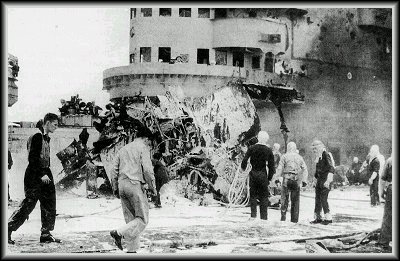
The picture above shows the damage that was caused by a
Japanese "Kamikazi" aircraft after it had targeted
and crashed on the deck of a British aircraft carrier. These
Japanese 'death pilots' aimed at different points depending on
the type of ship that they were going to attack. On an
aircraft carrier they aimed for the central elevator, on
larger ships such as battleships and heavy cruisers they aimed
just below the bridge and anywhere between the center and the
bridge of smaller ships and transports.
Later British aircraft carriers generally suffered less damage
than the American aircraft carriers because they had specially
reinforced steel flight decks. Whereas a "Kamikazi"
could easily penetrate the decks of the American carriers.
USS
INDIANAPOLIS (CA-35)
(July 30, 1945)
Launched on the 30th of March, 1930, this 9,950 ton heavy
cruiser served throughout the Pacific War until its final
mission. One of the wars most secret missions was the delivery
of the uranium core to be used in the 'Little Boy'
Hiroshima bomb. After unloading the component to the B29 Bomb
Squadron on the island of Tinian, the Indianapolis
departed for Leyte to join up with the USS Idaho for
gunnery practice before rejoining the rest of the US Fleet off
Okinawa for the expected invasion of Japan. Halfway between
Leyte and Guam, the cruiser was hit by torpedoes from the
Japanese submarine I-58 (Captain Hashimoto). The Indianapolis
rolled over and sank bow first taking the lives of 883 US
sailors. (Position 12 degrees-2 minutes north by 134
degrees-48 minutes east) There were 316 survivors from the
1,199 crew. Most of the men died in the water from exposure
and shark attacks. Of the thirty nine Marines on board only
nine survived. The survivors were rescued four days later by
the US destroyers Cecil Doyle, Talbot and Dufilho.
After hospital treatmrnt on Guam the survivors were soon on
their way home on board the carrier USS Holandia . The
captain of the Indianapolis, Charles Butler McVay, was
later court-martialed for failing to zig-zag in hostile
waters. His sentence was remitted by the Secretary of the
Navy, James Forrestal, and he was restored to duty. He
retired as a Rear Admiral in 1949 and in 1968, in Litchfield,
Connecticut, he committed suicide by a pistol shot to the
head. In July, 2001, Captain McVay was exonerated for the loss
of his ship. The Indianapolis was the last major
warship sunk in WW11 and America's greatest disaster at sea.
How different would history have been if the cruiser was sunk
on the outward journey taking the nuclear components to the
bottom of the ocean?
UKISHIMA
MARU
(August
24, 1945) In the Aomori Prefecture, in the
far north of Japan, around 5,000 Korean slave labourers had
spent the last few years of the war digging a major
underground complex of tunnels and storage facilities. With
the work completed and the end of the war just a few weeks
away the five thousand labourers were put aboard the Japanese
warship Ukishima Maru with the promise that they were
being returned to their homeland. The warship sailed south
along the west coast until it reached the Maisaru Naval Base
in Kyoto. There, the hatches to the holds were sealed down and
the ship taken offshore and scuttled. Explosives were placed
inside the hull, the resulting explosions sinking the ship
within minutes. There were only some 80 survivors. Fifty-seven
years later, in August 2001, fifteen of the survivors who were
still alive, won a lawsuit for compensation against the
Japanese government. They were paid the paltry sum of $30,000.
Info on the Sinking of the Ukishima Maru
On August 24, 1945, the Japanese cruiser Ukishima Maru sank in
a Japanese
harbor with more than ?? Korean slave laborers and their families
aboard. About
half of them were women and children. The Japanese gov, to
date, blames the
US for this incident. The ship hit an American mine and the US
command
ordered the ship to return to Japan. She was on her way to
Pusan at the
time. I am wondering if the US Navy has any archive on this
incident, which
is becoming a hot issue in South Korea. Eyewitness accounts
tend to
implicate the defeated Japanese Navy and exhonorate the Yanks.
- The ship left with not enough fuel to reach Pusan
- The ship changed her course and returned to a Japanese port
ostensibly to
pick up drinking water
- The Koreans were herded below the deck and the hatches were
locked down
prior to the explosion
- The Japanese crew abandoned the ship moment before the
explosion
- There was a wide spread rumor that the Japanese would be
killed if they
reached Pusan
- There was no water plumes with the explosion - actually,
there were three
explostions in tandem
- When the ship was salavaged nine years later, it was
discoivered the hull
and the deck were bent outward - implying the explosives were
placed inside
the ship - a string indication that the Japanese crew scuttled
the ship.
Mike Yared
OP ten
NOORT
(August 30,
1945) A
6,000 ton Dutch passenger liner based in Java and on regular
service between Surabaya and Singapore. Converted to a
hospital ship for the Dutch Navy at the outbreak of the war.
In harbour at Surabaya during the Battle of the Java Sea, she
was dispatched to look for survivors but was intercepted by
two Japanese destroyers and ordered to turn back to
Bandjarmasin in Borneo where she was boarded and apprehended.
Ordered to take on board 970 Allied prisoners-of-war,
including around 800 survivors from the British cruiser Exeter
sunk in the Java Sea battle, she sailed for Makassar and
there, for the next eight months served as a hospital facility
for the POW camps in the area. Later she sailed for Yokohama
under the Japanese flag and a new name 'Tenno
Maru'.
For the remainder of the war she sailed between Singapore and
Manila carrying looted gold and other treasures from the
Japanese occupied countries. Just weeks before the war ended
she arrived again in Yokohama loaded with 2,000 metric tons of
gold but instead of offloading her cargo she then sailed on to
the Maisaru Naval Base where more gold and platinum bars,
diamonds and other gems were put on board. (A metric ton of
gold equals 26,400 ounces) Realizing the war was over it
was decided to sink the ship and recover the treasure at a
later date. Just days before the Japanese surrender the Op
ten Noort was taken out into Maisaru Bay late at night by
a group of high-ranking Japanese naval officers. The Japanese
captain and twenty-four crewmen were shot dead and the ship
scuttled. When the wreck was found in 1990 the Japanese valued
the treasure at thirty billion US dollars (Three
trillion Japanese yen)
|