


|
LA TRAGEDIA DEL THETIS Aún no había transcurrido una semana del hundimiento del Squalus, cuando el submarino britanico Thetis, de la clase T, dejaba los astilleros Cammell Laird, de Birkenhead, para realizar pruebas de mar, llevando a 103 personas a bordo. A las 14.00 del 1 de junio de 1939, el comandante dio orden de sumergirse, pero la operación no pudo llevarse a cabo porque el peso del lastre estaba equivocado. Incluso después de haber llenado los depósitos auxiliares, la situación no mejoró. Se pensó entonces que la causa más probable de la excesiva flotabilidad era debido a que todos los tubos lanzatorpedos estaban vacíos. Se mandó comprobarlo al oficial encargado de los torpedos, y se descubrió que la suposición era cierta a medias. Los indicadores de posicion de las tapas señalaban que todas estaban cerradas, y las válvulas de seguridad indicaban que los tubos estaban secos Pero los pequeños conductos de las válvulas habían quedado obstruídas al pintar el interior de los tubos y por tanto si informacion no era confiable. Cuando el oficial aflojó la última tuerca que fijaba la tapa del n' 5, se produjo una entrada de agua a tal presion, que indicaba que el tubo estaba en comunicación directa con el mar. El oficial torpedista iriformó a la cámara de gobierno de la situación y sugirió vaciar el lastre principal. Luego intentó cerrar la puerta estanca del compartimiento, pero no lo consiguió porque se trabó un volante. El Thetis, cuya excesiva flotabilidad quedó compensada por la imprevista entrada de agua, descendió rápidamente hasta el fondo, a 49 metros.
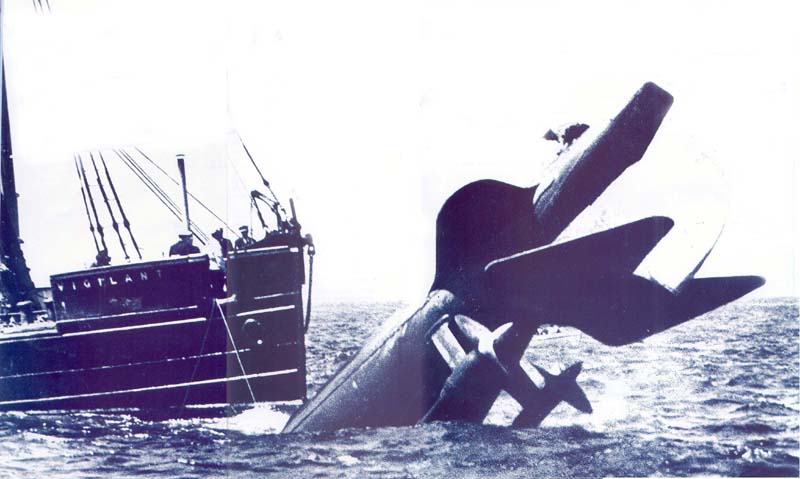
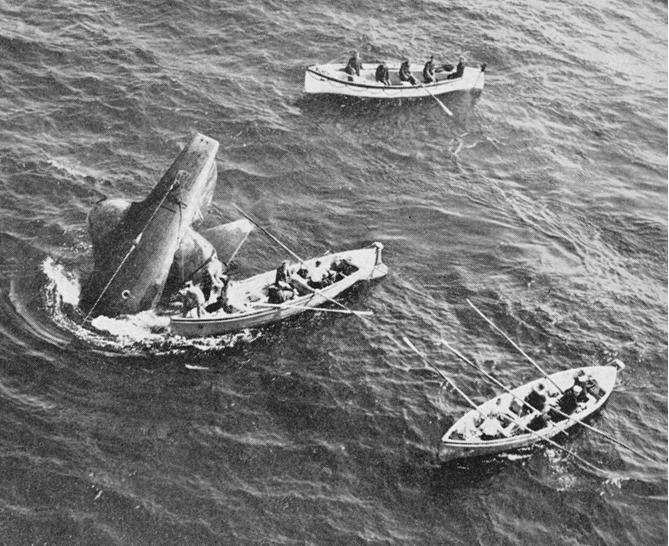
La popa emergiendo del agua Un intento de llegar a la cámara dc cerrar la tapa del tubo de torpedos Nº 5 fracasó por falta de equipos respiratorios adecuados. También falló el intento de extraer agua de los compartimientos de proa usando aire comprimido, pues había quedado muy poco despues de vaciar el lastre principal. Dado que el aire era cada vez más irrespirable, se decidió vaciar ellastre de nivelacion popel para levantar la popa y facilitar la salida del personal. No obstante, la operación se realizaba manualmente nualmente y comportó el consumo de buena parte del oxígeno restante. Entretanto aumentaba la preocupacion a bordo del remolcador que había acompañado al Thetis durante las pruebas. El único buque próximo era el destructor Brazen, que se acercó al ser llamado para colaborar en la búsqueda del submarino. Al amanecer del día 2 de junio fue descubierta bajo el agua el extremo de popa del Thetis, pero para entonces el aire interior ya no era respirable, y hacía tiempo que no se bombeaba el lastre. A las 07.30, dos voluntarios a bordo del submarino entraron en la esclusa de escape, cerca de la popa, inundaron la zona, abrieron la escotilla y salieron impelidos hacia la superficie, donde fueron rescatados por el Brazen. Dijeron que los demás les seguirían, pero tuvieron que pasar más de dos horas para que vieran emerger a dos hombres, que contaron un terrible relato. Se eligió a cuatro marineros para la segunda salida -dijeron-, pero en la oscuridad de la inundada cámara de escape tuvieron dificultades para abrir la escotilla. Uno de ellos fué presa del pánico y dejó caer la boquilla. En la confusion generada tambien soltaron los equipos de respiracion los demás, cuando los hombres del submarino aun conscientes inspeccionaron la cámara descubrieron tres cadaveres y un cuarto marino agonizando. Los dos náufragos añadieron que sólo consiguieron salir y huir del buque averiado con grandes esfuerzos y que era poco probable que otros pudieran seguirlos. Muchos observadores afirmaron que los socorristas debieron de cometer algun error y que, con la escotilla tan cerca de la superficie hubieran tenido que hallar un modo de salvar a los hombres del interior. Pero evidentemente tales observadores no conocían el proyecto Thetis: de hecho, no podía entrarse en el submarino por aquella escotilla que era sólo de salida. Cualquier intento de abrirla desde afuera solo hubiera servido para inundar al buque.
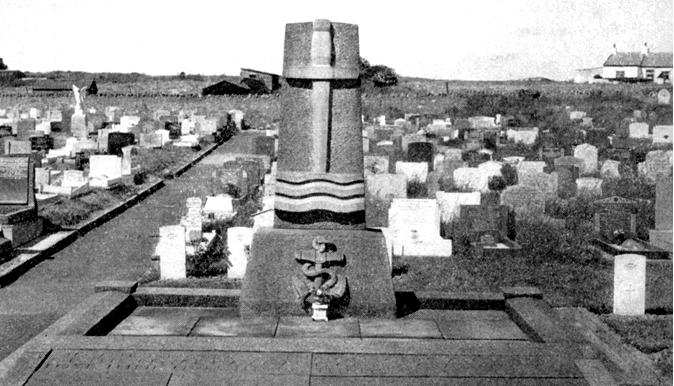
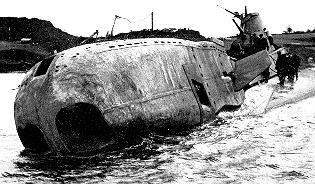
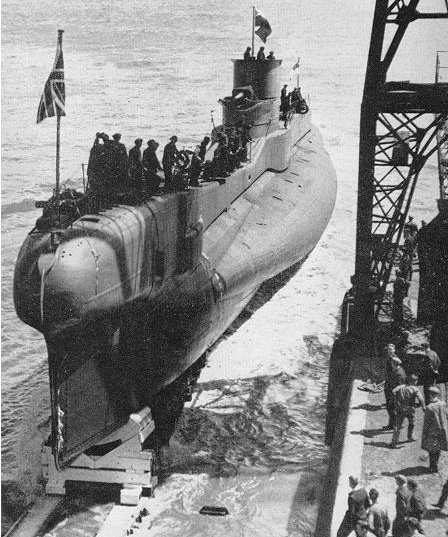
Monumento a los muertos del Thetis En baril de 1940 el Thetis fué recuperado y puesto en servicio con el nombre de Tnunderbolt, pero la mala suerte lo siguió. Volvió a hundirse, se recuperó de nuevo y se hundió una tercera vez.
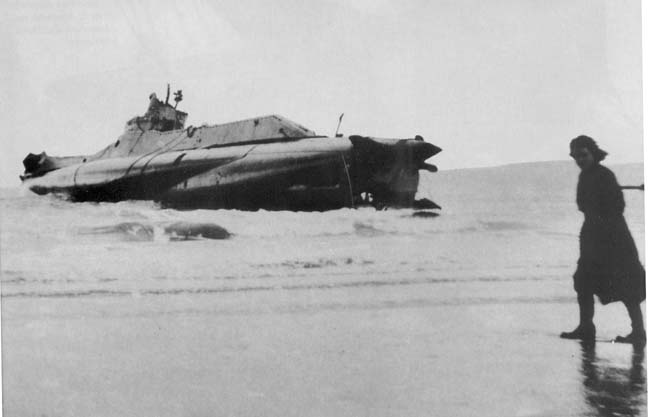
El Thunderbolt (ex- Thetis) encallado en la costa de la isla de Anglesey, Gales en 1940. Segun algunas fuentes, el 13 de Marzo de 1943 el Thunderbolt fue destruído por la corbeta antisubmarina italiana Cicogna y otras 65 victimas se agregaron a las anteriores 99 muertos en la bahía de Liverpool. Pero otra version pretende que el buque habia sido hundido por los alemanes en el Kattegat muchos meses antes. Encallado en la costa
|
|
Shortly before 10 A.M. on June 1st 1939,Her Majesty's Submarine Thetis left Birkenhead under the command of Lieutenant Commander G.H.Bolus (RN). The principal purpose of the day was to make a diving trial. This was to be Thetis's first venture as a submarine proper. She had on board 103, fifty more than her normal crew. Of the extra fifty on board 8 were Naval Officers some commanding their own Submarines anxious to see the performance of this new class of Submarine. The others were Electricians, Engine Fitters, and Ship Fitters employees of Cammell Laird and Vickers Armstrong. There were two employees of a catering firm on board for the reception that normally follows the sea trials,and finally the Mersey Pilot. Five hours later she was lying, sunk, 160 feet down, with her bows stuck in the mud. Although only 38 miles from land, 99 lost their lives, only 4 survived. Two months earlier she headed out to sea for her first sea trials for engine and steering. During these trials the steering gear was found to have been connected the wrong way round. When ordered to go to starboard she would swing to port. It seemed strange that acceptance machinery tests, supervised by Admiralty overseers, should have failed to detect so obvious a mistake. It had been intended to carry out a diving trial in the Gare Loch, the traditional site for all such proceedings in the Clyde area. However, during the initial test of the hydroplanes they jammed in the "hard to dive" position. Despite the efforts of crew and Cammell Laird staff on board it could not be shifted. So the trials were postponed. As HMS. Thetis headed out to Liverpool Bay she was headed by the Liverpool Screw Towing and Lighterage Company's tug Grebecock to act as escort during the trials. It was also the duty of the tug to take the passengers from Thetis before she commenced her first dive. At 1.30 p.m. the tug received a signal from Thetis that all passengers had decided to remain on board Thetis and that the dive would commence. At 2 p.m. sharp there was a "whoosh" of the air rushing out of Thetis tanks, which could be clearly heard by the crew on board the tug, Thetis had opened her main vents. For the next 50 minutes the crew on board Grebecock watched the Thetis disappearing slowly below the surface in what was a dive in slow time. She had her bow down a slight angle and appeared to have difficulty getting below the surface then at 2 minutes to 3 p.m. she went down suddenly. What happened
on Thetis was a series of circumstances that would give one to
believe that she was doomed from the start. When Lt. Cdr.
Bolus ordered the dive it was found that she was light and
needed more weight forward. This would entail taking more
water on board. It was decided to check no 5 and 6 forward
tubes which should have been filled with water to effect the
ballast in the absence of torpedoes. The bow cap out of which
the torpedo leaves the submarine is opened to let in water if
the tube is to be flooded for ballast. However, it is obvious
that the rear door of the torpedo tube into which the torpedo
is put would have to be closed, otherwise the whole submarine
would very quickly flood. On this rear door there are small
holes that can be opened by a lever. When this lever is opened
the water in a controlled manner will spill out if the tube is
full. If no water drips out then it indicates that no or at
least very little water present in the tube. The rear door can
then be opened.Unfortunately for HMS Thetis during the
painting and enameling these inspection holes did not seem to
have been plugged before enameling and were painted over
creating a seal in the inspection plugs. It was this one
simple factor that was to have dire consequences for HMS
Thetis. Thetis had two escape chambers one right forward and the other right aft, she also carried sufficient Deep Sea Escape Apparatus (D.S.E.A) for all 103 on board. She also had sufficient air on board for 36 hours. However, as Thetis had twice the number on board this was now reduced to 18 hours. All power to the engines were cut as Thetis settled on the bottom 160 feet below the surface and unknown to anyone 1 mile away from her escort on the surface, who by now was convinced something had gone wrong with the dive. Thetis was to surface after 15 minutes and commence another dive. The escort tug realizing the time for Thetis to surface had long passed sent a signal to this effect to the shore support. Unfortunately the tug was not equipped for such an emergency nor was she capable of holding her position and had drifted in the strong current some 4 miles from the position Thetis lay. The Thetis and her position was lost and darkness closing in. On board Thetis it was decided to empty the after tubes which would have the effect of raising the stern. The Thetis was 270 feet in length so it would rise well out of the water that was 160 feet at that time. Having pumped the after tubes the stern of Thetis did rise until the stern of Thetis was in effect sticking 18ft out of the water. Unfortunately, it was now dark and Thetis was 4 miles from the search area. The after escape hatch through which any escape attempt was to be made was 20 ft below the water line. No escape attempt could be made until it was established that there was a surface craft above to retrieve the escaping crew. All that Thetis could do was wait. It would be a long night. All throughout the night surface craft searched frantically for any sign of Thetis. One hour after daylight a searching plane noticed a black object sticking out of the waterand finally confirmed that HMS Thetis had been found, the time was 0745, 18 hours since her dive and at the estimated limit that men could survive in Thetis. Conditions on board Thetis were extreme the men were very weak due to lack of oxygen. All on board would be suffering from headaches. Surface craft rushed to the area where Thetis was sighted and immediately hammered on the hull of Thetis to let her know help was at hand. It was time for
an escape attempt. This would require the use of the breathing
apparatus and entering the chamber, which would be filled with
seawater. The hatch could then be opened for the escape 20
feet up to the surface. In the meantime hawsers had been successfully secured to Thetis and things began to look better although the carbon dioxide concentration on Thetis would by be above normally accepted fatal density. It may have been at this point that things would begin to go badly wrong.Most of the remainder on Thetis were by now to weak to perform the necessary operation of securing the hatch in the escape chamber. It was certainly the last attempt to escape that caused for the second and final time two hatches to be opened at the same time. It will never be known how or why but at this last attempt the sea flooded the Thetis. Within seconds all occupants of His Majesty's Submarine Thetis succumbed to the abrupt rise in the concentration of carbon dioxide that the rapid increase of pressure instantaneously caused. Long before sufficient water had entered Thetis to bring about the struggle and fight against drowning, the merciful gas had quietly and quickly killed them all, many of them while they slept. The tons of water that flooded HMS Thetis put tremendous strain on the hawsers securing the stern of Thetis on the surface. It proved too much of a strain and the hawsers parted. HMS Thetis disappeared below the surface and finally rested on the seabed of Liverpool Bay. It would be three more months and many attempts before HMS Thetis was finally raised and beached. But not before another life was lost, this was a diver who suffered with the bends during a recover attempt. This brought to 100 the number of lives that were lost. When the bodies were finally recovered from Thetis they were buried in a mass grave at Holyhead Thetis Captain Lt.Cdr. G. H. Bolus was buried at sea. .HMS Thetis was salvaged, repainted and renamed HMS Thunderbolt. It is with regret that we note that she also perished at 8.54 a.m on the 14th March 1943. She was dept charged and sunk by the Italian Sloop Cicogna. The Submarine that was first Thetis and then Thunderbolt rests 3000 feet down in the pitiless waters of the Mediterranean. |