By ROBERT A. HAMILTON
Day Staff Writer, Navy/Defense/Electric Boat
Published on 4/22/2005
A preliminary report on the
submarine that hit a seamount in the Pacific three months
ago concludes that numerous warnings of shortcomings in the
ship's navigation department existed at least a year before
the accident.
In a January 2004 inspection,
the USS San Francisco crew did not properly use its
fathometer warning system and its electronic Voyage
Management System, or VMS, which were both factors in the
accident a year later, according to the report, a copy of
which was provided to The Day.
In August 2004, during
another inspection, the San Francisco navigation team was
found deficient in the chart review process, and in a
certification process in October 2004, the team failed to
adequately highlight hazards to navigation on the charts,
the report found.
The report outlines a series
of weaknesses in the navigation process starting before the
San Francisco left port that led to the Jan. 8
grounding that killed one crewman and injured almost
everyone on board, 29 of them seriously enough to require
hospital care.
The navigation and command
teams on SFO (San Francisco) failed to develop and execute
an effective voyage plan that would ensure the safe and
prudent navigation of the ship, says the Mishap
Investigation Report, as it is known. This was the
fundamental cause of the grounding.
The report paints a grim
picture of the first minutes after the accident, when the
engineer did not recognize the ship had lost almost all its
speed the speed indicator was stuck on 25 knots as a
result of the crash and did not take steps to
compensate for the reduced maneuverability of a submarine at
slow speeds.
This could have had drastic
consequences,†the report says. Although this lack of
action in maneuvering did not contribute to the grounding,
it could have resulted in the loss of the ship and crew had
the forward main ballast tanks not held enough air to
provide upward momentum.
Within six seconds of the
crash, however, the crew had the submarine in an emergency
blow, rising quickly to the surface, but with the bow down
as much as 14 degrees as it climbed 525 feet in less than 90
seconds.
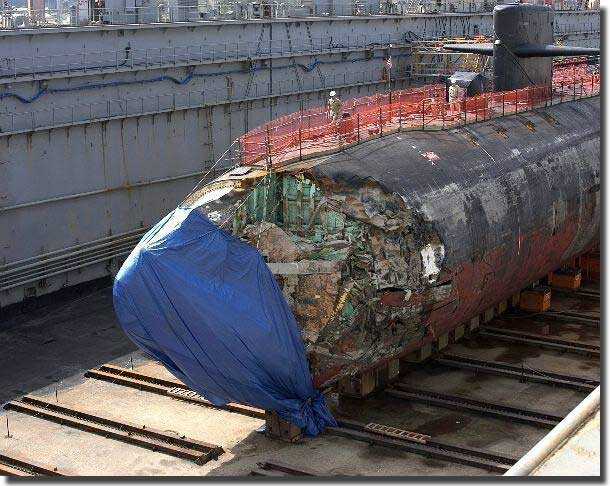
The report provides
considerable insight into the damage aboard the ship, and
estimates it will cost $88 million to repair, though it
cautions, ocean engineering assessment is in progress that
could substantially change this estimate.
The report notes that all
four torpedo tube doors were deformed and inoperable; that
15 torpedoes and two Tomahawk missiles had to be repaired,
that the sonar dome was smashed and mostly missing and that
the sonar sphere was breeched, along with three main ballast
tanks.
It also lists page after page
of other damage, such as computers, lockers, lights and
other equipment that was smashed by men flying through the
air.
The report praised the ship
for doing an exceptional job at making sure equipment was
stowed properly before the accidents so loose gear was not
turned into missiles, and for a response to both the
mechanical and medical problems that was very effective.
The report found fault with
Submarine Squadron 15 in Guam, where the San Francisco is
based, and with Submarine Group Seven in Yokosuka, Japan,
which oversees Squadron 15.
There has been considerable
griping within the submarine community that that the San
Francisco crew has shouldered all the blame while
higher-ups have escaped criticism.
Although the report placed
the blame for the accident squarely on the navigation team
and command team on the San Francisco, it found that the
squadron and the group could have done more to prepare the
ship for sea.
In particular, the report
noted that the squadron did not take adequate action to
correct previously identified deficiencies in open ocean
navigation onboard SFO, and did not even require the ship to
report what it was doing to fix the problems.
In addition, the squadron did
not provide adequate oversight of the San Francisco's
navigation performance because it was understaffed, with two
positions unfilled, and the squadron assistant navigator was
assigned to one of the other squadron submarines for most of
the previous year.
The report also notes the
document known as a subnote from the Group, which laid out a
path and average speed, was delivered to the ship
two-and-a-half days before San Francisco sailed, and the
Group's own requirements are that it be to the ship three to
five days before sailing.
But the report found the
submarine captain spent as much time as he usually did
reviewing the charts, as did other members of the navigation
team, and that the timing of the Subnote did not contribute
to the accident.
Although the ship felt that
the late delivery of the Subnote did not affect the method
in which the voyage was planned, reviewed and approved, that
is only because their process lacked the rigor to ensure
such adequate voyage planning was accomplished,†the
report concludes.
Capt. Matthew S. Brown, a
spokesman for Adm. Walter F. Doran, commander of the U.S.
Pacific Fleet, said the Mishap Investigation Report is an
internal document, intended as a quick review of an
accident.
'm not going to discuss the
contents of a report that is not releasable, Brown said. He
said the final command investigation will be out soon,
perhaps within another week or two, that will go into much
greater detail.
San Francisco left Guam just
before 8 a.m. Jan. 7, headed for a liberty port call in
Brisbane, Australia, according to the report, prepared by a
team led by Capt. Kenneth D. Walker, commander of the
Pacific Naval Submarine Training Center, in the weeks
immediately after the accident.
At 1:53 a.m. the morning of
Jan. 8, the navigation team shifted to chart E2203, which
generally showed water depths of 7,200 to 7,800 feet along
its intended path. But less than five hours later, the
ship's fathometer recorded a depth of 5,610 feet.
From 6 to 7 a.m., the
soundings were all about 1,200 feet shallower than what was
shown on the charts. At 7:30 a.m., the ship went to
periscope depth to use the global positioning system to fix
its position on the charts accurately, and submerged again
at 9:48 a.m.
At 11 a.m. the fathometer
reported 8,652 feet of water; at 11:15, 5,988 feet; at
11:30, just under 6,588 feet.
At 11:43:21 a.m., the San
Francisco ran into an underwater mountain at a speed greater
than 25 knots, just as the crew was finishing lunch.
Machinist Mate 2nd Class
Joseph Allen Ashley was killed as he was thrown into a large
piece of equipment in the machinery spaces. Dozens of others
were seriously wounded, and early all of the 138 crew
members suffered some sort of injury, according to the
report.
The investigation team
faulted the San Francisco for not recognizing the shoaling
water and for not becoming more cautious when the depths
that were showing up on the fathometer did not match what
was on the chart.
And it said the submarine
should probably have been doing more than one sounding every
15 minutes and certainly should have done one when the
submarine changed its depth from 400 to 525 feet at 11:39.
Had they taken a sounding at
this point (four minutes prior to the grounding) it is
likely that the sounding would have indicated a depth
significantly shallower than charted water depth, the report
found.
A more serious problem
emerged from a review of the use of charts on the San
Francisco, the investigation found.
All members of the (San
Francisco's) navigation team believed that the E2202 chart
was the best information available and that it was based on
extensive U.S. Navy surveys, the report found. This
assumption was invalid.
In fact, the investigation
team said, there was a notation that some of the features on
the chart might be off by as much as three nautical miles,
and the submarine had at least three other charts on board
of the same area that showed an area of muddy water that was
an indication of a seamount.
The only chart on which this
report does not appear is E2202, the chart in use at the
time of the grounding, the report says.
The investigation also found
that the navigation team did not understand the nature of
the hazards in the Caroline Island chain, where the accident
occurred. Generally ships are told to use caution within 12
nautical miles of land; the San Francisco team was under the
impression that two miles was sufficient.
San Francisco had one of the
most advanced navigation tools available today in the
submarine force, the VMS. Though the system was not
certified as a primary navigation tool, the ship could have
programmed its Subnote into the system.
Had this been done, the ship
would have received a warning, alerting them to the presence
of a navigational hazard along the ship's track, the report
says.
It found that the failure to
use VMS was the result of a lack of training, lack of
adequate procedures and lack of supervision by both the
internal and external chains of command.
The report found that the
Subnote did route the San Francisco through the area where
it hit the seamount, and it recommends that in the future
the group take more care to route submarines around known
navigational hazards. It also said the Subnote specifically
states that navigational safety is not provided by the
Subnote and rests with the ship.
Each member (of the
navigation team) had an initial reaction of unease when
viewing the charted transit through the Caroline Islands,
the report says. However, each member convinced himself,
without careful assessment of risk and evaluation of
possible offsets, that the transit could be made safely as
laid out on their chart.
After failing to conduct a
proper assessment, the ship was left with a business as
usual' attitude exemplified by the CO's comment that he was
operating on a 40 (nautical mile)-wide highway, it
continues.
The investigation also
rejected the notion that the average speed laid out in the
Subnote was too high, even though it was higher than the
average in the last 30 Subnotes issued by Group Seven. In
fact, at the time of the grounding, San Francisco was almost
40 miles ahead of where it had to be, and was going faster
than required for operational considerations.