

By Mariano Sciaroni
|
The attack on the 30th May 1982, carried out by Super Etendards of the Argentine Naval Aviation and A-4C Skyhawks of the Argentine Air Force, resulted in one of the most controversial episodes in the South Atlantic War.
What is laid out here, is what occurred according to accounts exclusively
from members of the British Task Force. The objective of this study is not to arrive at or produce a definitive story of the attack, not to arrive at a balanced version of the same. In short, it is only an attempt to relate what British sailors said happened that day. That is to say, to reconstruct, within all possibilities, a part of the truth.
It must be said many times it is considered that the "British version"
indicated that there was an impact on the burned hull of SS Atlantic
Conveyor (sunk days earlier), that the Exocet had been shot down in flight,
amongst other theories put forward, some seeming to be malicious. We hope
that this small study brings to light what is considered to be the
definitive version according to the Task Force.
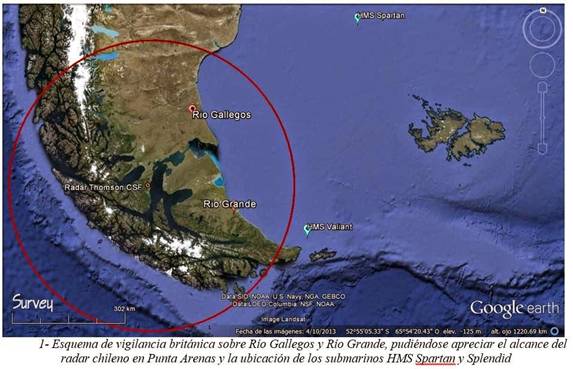
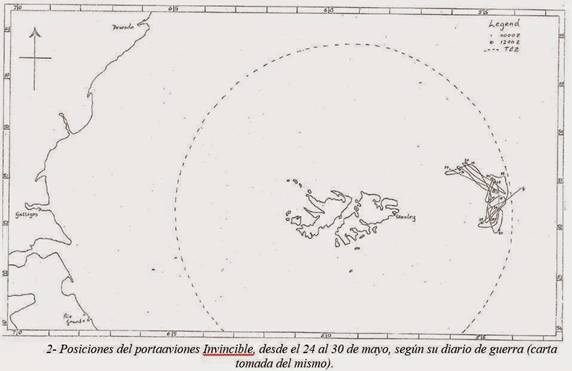
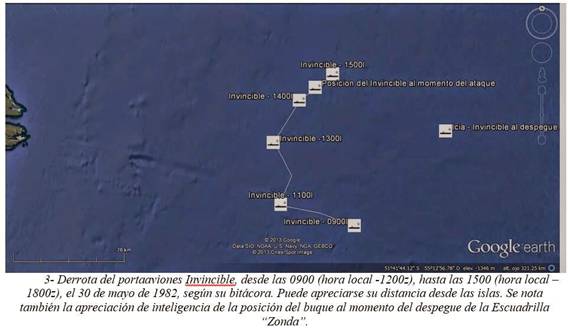
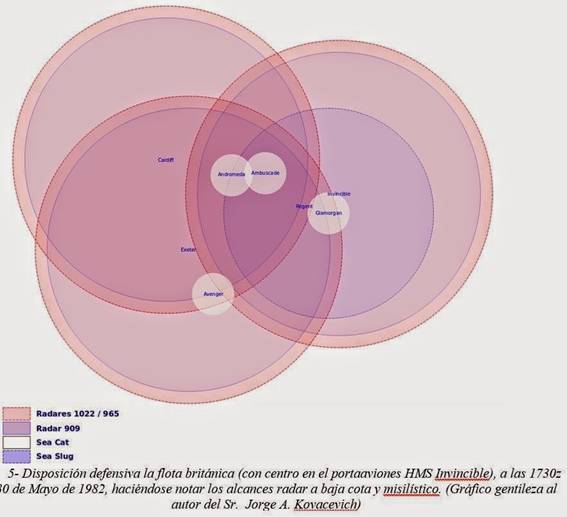
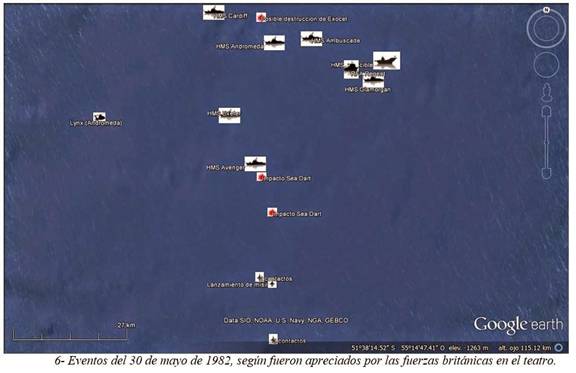
I.- For the British CVBG, commanded by Rear Admiral John Forster "Sandy" Woodward, the afternoon of the 30th May 1982 would pass without too much distress. Although had the Exocet impacted on (and then sunk) the remains of the container ship SS Atlantic Conveyor, it would have demonstrated the Argentine capacity to penetrate the heart of the fleet, which hadn't taken additional measures to protect the the two vital aircraft carriers: HMS Hermes and HMS Invincible. Lacking an embarked airborne early warning asset, the first alarm of a possible attack came from the submarines stationed along the Argentine coast as well as a Chilean Air Force (FACH) positioned on a mountain near to Puntas Arenas (2), which with its 200 nm reach, covered the air bases of Rio Grande and Rio Gallegos. In both cases, along with information provided by special forces located inside Argentina (3), any notification arrived directly at HMS Hermes via the secure channel, and then distributed to other ships. In this way, there was a prior notice of some 30 to 40 minutes - the time it would take an aircraft to arrive from the continent to a target in the Islands, or close by. However, HMS Valiant, a nuclear submarine under the command of Commander Tom le Marchant, operating in the vicinity of the Isla de los Estados did not make any significant detections that could have alerted the carrier group (4). It is worth pointing out that the previous day it had detected with its ESM equipment the radar of a Super Etendard (5). Nevertheless, the warning of a possible aerial attack ("yellow alert"), arrived at 16:45Z from one of the other sources mentioned above. Forty minutes later, without anything having happened, the alert was cancelled. The British ships located away from the islands, therefore, were no longer expecting any further enemy action. At this moment, the nucleus of the fleet, centred on HMS Invincible, was located some 110 nautical miles from Port Stanley on a bearing of 080º (7), formed in a shape that provided the maximum possible protection against a possible air attack from the West or North West. At this moment, it is worth mentioning that the previous Exocet attack (on the 25th May) had come from the North and especially that the British intelligence services had mistakenly belived that the Super Etendards of the 2nd Aeronaval Attack Squadron (the only unit that could launch the French air surface missile) for the Aeronaval Command were able to operate from the runway at Puerto Deseado (another airfield located to the NW of the islands on the Argentine coast) (8). This conviction remained for several more days, and was so strong that on the 2nd June a unit of the SBS, on board the submarine HMS Onyx, were ordered to disembark in the said locality and destroy the airfield installations. This mission was later cancelled the next day when the submarine was en route (9). Returning to the disposition of the fleet, three destroyers armed with Sea Dart anti aircraft missiles were loacted in a semi-circle that, like a shield, provided protection to the nucleus. From the North to the South, HMS Bristol (Type 82), HMS Cardiff and HMS Exeter (both Tpye 42s) were scanning the skies for enemy aircraft, located at a distance of between 25 and 35 nm from the centre of the fleet. As an inner protection screen, especially providing an anti-submarine screen, between 5 and 10 nm from the centre of the formation, were the Type 21 frigate HMS Ambuscade and the County class destroyer HMS Glamorgan, both with missile systems of smaller range. Close by HMS Ambuscade was the Leander class frigate HMS Andromeda. The inner ring and the nucleus of the fleet (whose guide that day was RFA Regent) included other frigates, such as HMS Plymouth and HMS Alacrity), logistic and support ships as well as HMS Invincible (10). Unusually, the aircraft carrier did not have any close in escort ship (11) armed with the lethal Sea Wolf missiles. Invincible also had another problem, that day her own Sea Dart system was out of operation (12). The other aircraft carrier, HMS Hermes, was located seven nm to the north of Invincible (13). It is worth adding that the weather that day was not bad, with a visibility of 10 nm, limited only by some isolated squalls(14). II.- The calm that afternoon was broken at 17:30Z, when an operator of a FH5 (a HF Direction Finder based on tube technology with its origins in the second world war(16)) on HMS Exeter detected voices in Spanish on the frequency of 12.333 KHz. Although it was not possible to understand what these voices were saying (due to the limitations of the equipment) or the direction of the transmission, immediately an alert was ordered within the fleet assuming that an attack could be materializing (17). At this moment, the Lynx HAS. 2 from the frigate HMS Andromeda (XV722 affectionately known as "ARFA") manned by Commander Bob McKellar (commanding) and Lt. Larry Jeram-Croft (pilot - in the Royal Navy the highest ranking officer was commander of the aircraft whether or not he was the pilot) was some 15/20 nm to the West of Exeter (18). The flight was relaxed and the the crew had the task of providing early warning of an attack, for which they used their Orange Crop ESM equipment, as well as their eyes, which was originally designed and developed to intercept and locate submarines based on their transmissions. Additionally, it possessed some electronic counter measures equipment. "We were the only Lynx on picket duty - all of the Lynx in the fleet took turns to do this. The ECM equipment was not necessary for this task, the important set for this was the "Orange Crop", our ESM, which all Lynxes had at this time. It was the only way, from the air, that we could detect with sufficient early warning, the radar from a Super Etendard. The helicopters, patrolled out in front of the force while listening out for an early detection of radar emissions. Suddenly, the "Orange Crop" detected a radar, which was clearly an Etendard. We called the controller in Hermes and informed him of a contact to the South. At the same time, one of the ships alerted the detection of the same radar and confirmed the detection (20)". Effectively, at 17:31Z the UAA1 ESM equipment on HMS Exeter detected the emission of an Agave radar (21) (as carried by the Super Etendard) to the South of the formation. On the transmission of the word "HANDBRAKE" (the code word for the detection of this type of radar), the fleet prepared to deal with another missile attack. Immediately, HMS Ambuscade and HMS Glamorgan corroborated the information, announcing over the net the detections of this radar as well (22). Able Seaman Ken Griffiths, an radar operator on HMS Cardiff found himself standing behind one of their radar screens at this moment. "The red alert was transmitted on HF and UHF, on the air defence net frequencies. Additionally, HMS Exeter put the information on the Link 10, I could see it on the radar. Link 10 is a secure, encrypted method of transmitting one ship's radar to other radar screens in the fleet. It uses HF and UHF and, basically allows you to see what the other ships can see. In theory, it replaced reports via radio between ships, but this was not usually the case in 1982 (23)”. Bearing in mind the profiles of the previous Argentine missions, it was assumed that another attack with Exocet was imimnent (Codeword "Zippo 4") (24), the automatic response to which was the launching of Chaff, small specially cut metal foil strips, by the all ships of the force (remembering that the requisitioned ships lack this type of defence (25)). The idea was that by everyone launching Chaff "Delta", this would create false echos which would confuse the attackers. With a reload of the Chaff rockets limited by the manual effort required, what had been ordered (for a frigate or destroyer) was the firing of twelve chaff rockets in the case of a Zippo 4 instruction, with the end that another firing could take place almost immediately with the remaining four rockets in case that it was necessary (there were usually sixteen rockets primed to be launched) (26). Also, follow pre agreed directives, ships would turn in order to put their starboard quarter in the direction of the attack (27). A minute later (1732Z), the 1022 radar of HMS Exeter detected 3 contacts to the south at 29 nautical miles, which was also detected by the 992 radar operator on HMS Invincible who established contact with two bandits (28). At this moment the ESM equipment on HMS Ambuscade informed that the parameters of the Agave radar had changed to a short pulse of high repetition. It was considered that the Argentine pilot was looking for a better picture on his screen, or it was the emission from the radar on the other aircraft. On the bow of Exeter, the Sea Dart launcher rotated abruptly and with two targets locked (one on each of the ship's 909 fire radars located under the white domes on each end of the ship), in rapid succession she fired the two waiting missiles, which took off leaving a large white trail of smoke behind them. The ship, with the improvements introduced with the second batch of these ships, benefited from the latest updates in equipment and software, as well as having a commander who was a specialist in electronic warfare and communications. All of this gave it an advantage of up to fifteen seconds when it came to fire its missiles in comparison with its batch 1 sisters, such as HMS Cardiff. (29) The missiles, heading off to the South, separated from their boosters and began their intercept course against the incoming contacts and disappeared from sight. III.- The Type 21 frigate HMS Avenger found itself at this moment fortunately to the South of HMS Exeter, on its way from the heart of the CVBG towards the islands in order to attempt to disembark 24 members of the SBS in the area of Volunteer Beach to the North of the capital - an operation that had been attempted the previous night due to the non serviceability of the ship's Lynx helicopter. (30)
Prior to the attack, it had found itself in a calm sea, so calm that the crew had been ordered to reposition the 20mm Oerlikon cannon during its transit to the islands. In an almost stationary flight, in the area of the flight deck of the frigate was a Wessex V (Yankee Delta of 848 Naval Air Squadron) which was delivering spares for the ship (32). At the moment of the initial alarm, the direction of the attack was initially misreported in the Operations Room at the heart of the ship as coming in from the North, instead of the South (the message from Exeter was not sufficiently clear, such is the case that it was reported incorrectly in Invincible). Therefore Avenger turned in order to put the stern of the ship and her Sea Cat missile launchers in the presumed direction of the attack, at the same time firing off its chaff countermeasures and increased speed to escape from the area of the attack. (33).
The Wessex was then ordered to move away from the ship (it had nearly been
hit by the chaff missiles fired by the ship), something that it only
partially carried out - it remained in the area of the stern of the ship
(34). Clearly, the ship was heading towards the enemy (not away from it), and in which manner the chaff which had been fired by the ship was being left behind and would be of scarce benefit. The commander, Hugo White, decided he could not run the risk of changing course and presenting the side of his ship as a target, but instead reduced speed to a minimum. (36) At almost the same moment, a few miles away, the always vigilant (and well equipped) operations room of Exeter detected the launch of the Exocet had taken place at 22 nautical miles to the South, corroborated moments later by Avenger, which evaluated that the missile launch had taken place on a bearing of 160º and 156 nautical miles to the South. Immediately they began to receive radar emissions from the homing head of the radar, which by now was searching for the target that had been given to it by the pilot of the Super Etendard (37). "Zippo 1" was transmitted on the network (meaning the missile had been detected at close distance") and the units of the fleet once again fired a new chaff pattern, now to confuse the homing head of the missile.
In Cardiff, miles behind the action, the situation was very confusing,
according to one of its radar operators. IV.- After having detected the launch of the missile, three of the screen ships detected the turn and escape of the the aircraft (one or two according to the informant), and at the same time multiple contacts continued to fly north at a speed of 527 knots (39). However, in the chaotic few seconds that passed, with an explosion on the horizon, it was assumed that at 17:34Z, the second missile launched by Exeter had impacted on its target.
On the radar screen in HMS Invincible the operator clearly saw the results
of a large explosion, which continued to be displayed on his screen for
three rotations of the radar (40). It's not clear what happened to the first
missile fired by the ship, but its launch scared the crew of Andromeda's
Lynx, which now found itself still in the area of the attack.
"We had a Lynx helicopter in the direction of the missile, which was coming back from a surface search mission. They would have been shocked, as they had an ESM system that would have detected the 909 radars, believing us to have locked them up with a missile. We told shouted at them to remain silent and to climb, because we knew that the Argentine attack would be coming in at love level. We wanted them to get out of the way. I don't think they heard us. Luckily, we didn't hit the helicopter." (42)
At that moment, Exeter already had a third missile in the air, which they
believed 30 seconds later (at 17:34Z and 30 seconds) had impacted in another
aircraft. According to the radar operator, despite the shooting downs, the
contacts opened up and continued the attack. To the South of this position, HMS Avenger followed the attack with its own radar. Its cannon, a Vickers Mk. 8 of 4.5" was ready to fire along the bearing of the attackers (calibrating the projectiles to explode at 4300 meters from the bow), and at the same time a light machine gun was being prepared to fire from the wing of the bridge. The 20mm cannon was still being moved to its new position on the flight deck. (44) There were no other anti-aircraft cannons available. Avenger, additionally, reloaded and fired another curtain of chaff, its commander considering that at this moment "he had discarded all desires to economise its use". (45) At 17:37Z, HMS Avenger, while manoeuvring beneath its chaff cloud, reported that it was under attack by 3 Skyhawks. There was some surprise in the other ships to find out that the attack was not exclusively an attack by Exocet. (46) The cannon was transferred over to manual controls and fired a curtain of fragmentation shells with proximity fuses (47), and at the same time opened fire with the only available machine gun. (47) On of the aircraft was shot down a short distance from the ship, which was thought to be an explosion of its own bombs or from the anti-aircraft fire. (48) The ship didn't report any damage (none of the bombs that fell into the sea exploded (49)), but reported having shot down an Exocet with one of the first salvoes of the cannon, and with retrospect, also a Skyhawk.
Lt. Commander Tony Bolingbroke, First Officer of the ship, at that moment of
the attack, was on the bridge of HMS Avenger.
The Master at Arms, Bill Jarvis, found himself in the same location as the
First Officer. Immediately after the report from Avenger, the radar on Invincible reported two contacts fleeing from the attacked ship at high speed. Exeter remained locked on with its Sea Dart system but its commander, Hugh Balfour, decided not to fire on the two aircraft that were retreating to the West. In addition, Sea Harriers had been ordered to intercept the withdrawing enemy aircraft, and they only had seven missiles remaining in their armoury with no expectation to receive more in the coming days.
For its part, Cardiff followed the action without being able to lock her
fire control radars on the aircraft: V.- On Invincible, two 820 squadron Sea King helicopters in anti-submarine configuration, that had been deployed the previous day to the RFA Tidepool to offer it more protection, had just landed on the deck when the incoming attack was reported. (54) On the stern of the ship, Lt. C.H. Cantan was sitting in his Sea Harrier, XZ495/003 (801 Naval Air Squadron) at Alert 5. (55) The aircraft carried its usual armament of 2 air-to-air Sidewinder model L missiles, two 30mm Aden cannons and two drop tank full of fuel. At this moment the order was given to launch, head on a bearing of 220º at 1500 feet. Shortly after, the pilot saw a wake, which the pilot considered to be a missile at low altitude heading NE, and detected momentarily in his Blue Fox radar a contact a distant air contact at some 12 nautical miles. Putting himself on a heading towards this contact, he was illuminated by a 909 fire control radar (possibly by HMS Exeter) which caused him to evade it and broadcast his presence on the different radio channels. Shortly afterwards, once he had got over his shock, he was told that his task had been cancelled as the contacts had opened to the West and given the distance to them, there was no reason to give chase. He then went to a CAP station to the South West, flying a total of 1 hour and 20 minutes before landing back on the aircraft carrier. From the other direction, Flight Lieutenant Ian Mortimer, also part of 801 NAS) had taken off from the carrier at 16:35Z for a CAP station close to the capital, where he didn't gain any contacts, but had received ineffective fire from the ground. (56)
He was on his way back to the carrier when he was informed by the air
controller of the Red Alert and the possible Exocet attack, being vectored
to a bearing of 130º towards a contact 45 nautical miles from his position.
That contact disappeared, but was shortly reacquired by the aircraft
carrier, this time at 27 nautical miles. (57) Flt. Lt. Mortimer closed to 10
nautical miles from the position, but by 17:50z the Alert had been
cancelled. It's also worth adding that at 17:19Z, a pair of Sea Harriers
(from 800 NAS) had taken off from HMS Hermes.
VI.-
Meanwhile, the Exocet had penetrated the screen, presumably passing close to
the starboard side and close to the stern of Avenger (without being seen by
anyone on board) and then close to Exeter.
For example, inside HMS Glamorgan, Ian Inskip, Officer On Watch on the
bridge: Glamorgan fired its cannon in the direction that the missile was coming from, adding to the confusion. Cardiff also opened fire with small arms, towards some explosions on the horizon, that were later determined to be the missiles launched by HMS Exeter. At 17:37:30 smoke was detected by HMS Ambuscade and then an explosion in the water, estimating this took place 7.8 nautical miles from the ship (bearing in mind information also gained from the frigate's radar). (65) At this moment, contact with the missile was also lost by HMS Andromeda. VII.-
During those confusing moments, the situation on board Invincible was not
very different, now sailing on a course of 060º. (66) Petty Officer Rod
Fearnley, on the flight deck of the ship, remembers looking for somewhere to
take cover in case of an impact. The attack, that was taking place outside
of visual range, was related as a commentary (seemingly somewhat
imprecisely) on the ship's speaker system. He noted in his diary for that
day: Another crew member, Warrant Officer Nicholas Lutwyche was in charge of some GPMGs that had been mounted for close in defence of the ship. With a thousand rounds at the ready, located on the forward port side walkway alongside the flight deck (close to the ships liquid oxygen plant) patiently waited for a target to appear, but he didn't see any. (68) VIII.- Minutes later, the Wessex V headed over to the site of the explosion of the second Skyhawk (close by Avenger), the water coloured turquoise and remains from the aircraft floating on the surface. (69) From Andromeda's Lynx it was also possible to see the coloured water and the remains of an ejector seat sinking slowly. (70) An NCO on board the Wessex lower a hook on a line and recovered one man life-raft , full of holes. Avenger also launched a boat and recovered a small piece of the aircraft and part of a body. I think it was a life jacket or something similar. I think the Wessex also recovered some other things.
IX.- The combat reports immediately after the attack were a little confused. Exeter reported that she had shot down a Super Etendard, and like that another aerial contact of indeterminate characteristics (72). At the same time Avenger logged an Exocet (73) and a little later added an A-4. (74) Days later, the Admiral's staff concluded that the CVBG had been attacked by one or two Super Etendards, accompanied by three or four Skyhawks (75), and that possibly Exeter, with its Sea Darts, had hit two of the A-4s. The commander of Exeter, additionally, in a new evaluation of the incident, concluded with 100% certainty that his ship had shot down one of the two A-4s (76). He also indicated that an Exocet had penetrated to the inner ring of ships, and that another possible Exocet had hung up and not left its launch aircraft, could not fly or had flown in tandem with the first. (77) However, with the analysis of the A-4s involved in the attack (that we know were four), he represented Exeter had shot down a second A-4 at 17:30:30 Z, when Avenger states that it was attacked by three aircraft at 17:37Z. Additionally, it was calculated that the launched Exocet ran for a total of 64 km (35 nm), in a straight line from where it was launched to where it fell into the water (that is to say more if one bears in mind the possible changes in course of the missile). The quotes distance is much greater than the maximum range of the missile if launched at low lever (around 50km). X.-
The attack on the 30th May 1982 took the British completely by surprise.
According to the commander of the fleet, “
According to the CO of HMS Exeter, Hugh Balfour: XI- Within just a few hours, it was clear (to the British Forces) that the attack on the fleet had involved the frigate HMS Avenger and the destroyer HMS Exeter as the protagonists. For this reason, the Officer On Watch had written in the part of the ships log reserved for the day's summary "Attacked by Super Etendards - no damage" (82); and Exeter's wrote "Defence Watches in the TEZ. Group attacked by Super Etendards" (83); and Avenger's recorded only "Defence watches - Operation Corporate". (84) Almost immediately the submarines in the theatre received the transmission "Four aircraft attacked and missed the Invincible, of which two were shot down.” (85). Finally, a report was created and sent to the headquarters, which informed the Cabinet and this informed Parliament that "An unsuccessful attack on HMS Invincible on the 30th May by Argentine Super Etendard aircraft equipped Exocet" (86). Therefore, the only thing that is clear was that nobody was exactly clear about what happened during the attack on HMS Invincible. References
1)- Sciaroni (2012:59-73).
11)- McManners (2007:184).
16)- Friedman (2006:393).
25)- Evans (2007). 59)- HMS Hermes ship log. At 1747z Hermes launched two Sea Harrier and two RAF Harrier Gr3
60)- King (1983:112).
75)- Operation Corporate – Analysis of Exocet firing 30 May 82. Bibliography. Publicaciones
Arancibia Clavel, P. y De la Maza Cave, I. (2003). British official records:
Logs:
Records of Operations: All documents on the National Archives británicos (at Kew), unless contrary statement.
People interviewed Bill Jarvis died last year. Rest in Peace.
Translation:
Andy Smith |
|
Este sitio es publicado por Histarmar - Argentina |
|
Direccion de e-mail: [email protected] |