


Seamen Can Learn from the Misfortunes of Others
By JOHN F. CAMERON - THE RUDDER 1950
|
IN ONE way harbors are much
like people. Some we may see for long hours day after day. But once out
of sight they vanish from memory like lightly held dreams. Others we see
only once, or rarely. Yet something about them strikes a spark in our
memories, kindles a flame that burns on forever. Perhaps it is only the
warm tone of a voice or the bright flash of a smile, the shimmer of
shore lights on water or the sweeping curve of a beach in the moonlight.
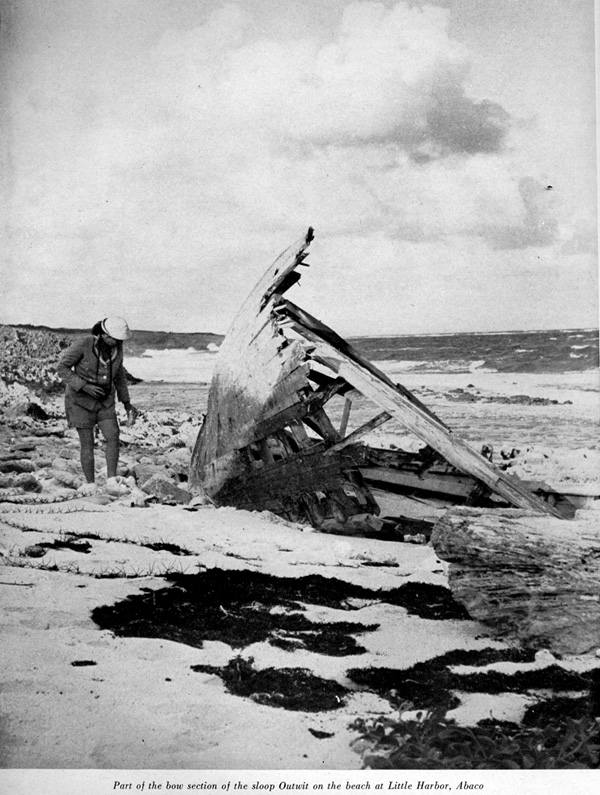
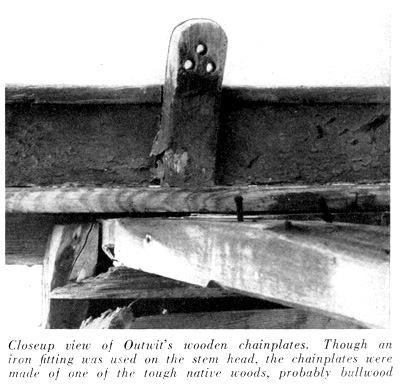
If it strikes the right spark it lives in us forever. For me one of those newer living memories is identified with Little Harbor in the Bahamas. If you plan to visit the Abaco Cays remember that no cruise is complete without spending a night in this well sheltered anchorage, and yarning with Pat Sawyer, the genial blue eyed giant who tends the Little Harbor light. Once inside (see Roland Rosinski's chart of Little Harbor, page 31, February, 1951, issue of The Rudder) there is plenty of room to anchor a dozen yachts in eight to twelve feet of clear water. Along the western shore there are caves that demand exploration, while smooth white beaches invite swimmers. Good crawfishing and conch beds are close at hand, and at certain seasons the nearby waters teem with bonefish. The shelling beach on the ocean side is well regarded by shell collectors for its yield of panamas and other unusual specimens. Along the northern end of the beach may be found the salt-whitened wreck of a native sloop. Among these attractions the shattered pine planks and twisted horseflesh frames of the wreck lay first claim to the sailor's attention. Long after the caves and loveliest shells are forgotten Pat Sawyer's account of the wreck of the sloop Outwit will live in my memory.
There had been trouble in the past at Little Harbor Bar when Pat's father was lighthouse keeper. But during the three years that Pat himself had been in charge of the light the wreck of the Outwit had been the only disaster. It happened early in January, 1950, after several days of strong easterlies had churned the Atlantic into a writhing mass of white water as far as the eye could carry. Night after night Pat had lit the warning lantern on the tripod in front of the lighthouse. Two white lights at Little Harbor, one fixed and one flashing, warn that "the rage" has made the bar impassable, that the southernmost channel from the sheltered water of the Abaco Cays to the ocean is closed. For two nights and a day the sloop Outwit of Ragged Island, Bahamas, had lain in the lee of Lynyard Cay just north of Little Harbor. Since long before Christmas she had been cruising among the Abaco and Grand Bahamas settlements, selling salt from Great Inagua. Now her cargo was sold. With light hearts and heavy purses the colored captain and his two brothers yearned for a brief shopping spree in Nassau, then a swift passage home. But the protected waters of the Abaco cays lay behind. Ahead stretched eighty miles of open water to Nassau, then almost 300 more before they reached their homes in Ragged Island. The three men waited, chafing while the wind howled taunts from the masthead. Late in the second night the captain heard the wind subside. "When Ah felt the wind die down Ah thought we could go," he said simply afterward. So long before dawn Outwit's anchor was stowed and she groped through the darkness toward Little Harbor channel. Two lights still showed from the point but the strength of the wind was spent. Who would expect the lighthouse keeper to leave his warm bed to take in the second light when the wind had still blown hard long past midnight? The sun was still below the horizon that morning when Pat Sawyer stepped out of his house to size up the weather. The wind had softened, he saw at a glance, but great herds of white horses still thrashed across the sea, and the booming gray waves threw up clouds of spray along the jagged limestone point. The sea still broke angrily all across the bar, where the outgoing tide knifed down the channel like a school of sharks in flight. The bar would be unsafe for another day, he knew. Then Pat saw Outwit slanting out toward the channel. The gray morning light and roaring sea made mockery of his efforts to warn the sloop off, so Pat went back inside to awaken his wife. "There'll be trouble on the bar today," he told her. "A man has need of a filling breakfast." Outside again, Pat watched Outwit work her way slowly toward more dangerous waters. At times the thirty-odd foot sloop seemed to vanish entirely in the tumultuous seas. Again she seemed bravely to be holding her own. Was it possible, Pat wondered, that she might work her way through those murderous seas ahead, might yet gain the safety of the smoother water offshore? In the strengthening light Outwit's captain began to sense the surrounding danger. Cautiously one of his crew crept forward along the wildly pitching deck and clung to the shrouds, studying the water ahead. There was a huddled conference in the cockpit and the captain decided to come about and run for shelter. The tiller went hard down, Outwit's bow inched slowly into the wind, and stopped. There she lay in irons, dead in the water. "The cuck of the tide took hold of her keel," Pat explained, "and she muscled." The captain backed his jib, and just as the bow began to pay off slowly the first gray sea roared across Outwit's decks, sweeping her water keg overboard. While she still staggered under a deckload of water a second sea boarded the sloop and tore away the dinghy, leaving Outwit low in the water. "Her sail was just stiffening," said Pat, "when the third wave came aboard. It broke her mast in three pieces and turned her bottom right up to the sky. Then she sunk down in the sea, and I saw three black heads bobbing among the wreckage." The youngest of the three struck out boldly for shore with the strokes of a powerful swimmer. Pat watched him drive straight through the waves to within a hundred feet of the rocky shore, then the current began to sweep him down the peninsula and back out to sea. Despite frantic efforts to reach a piece of wreckage drifting close at hand he was carried relentlessly out of sight. "I never found no tidings of him," said Pat sadly. "The sharks must have got him after he sunk down and drowned." Meanwhile the two older brothers were clinging to the largest piece of the mast. After a long time the current slackened and the mast began to drift toward the knife-edged rocks of the limestone shore. The wily watermen on the shattered mast moved to the seaward end of the pole as it pitched like a battering ram toward the rocks. Keeping the broken mast end-on toward the shore, they let it hammer time and time again into the cruelly sharp rocks. while they waited their chance in a lull between seas. Then when the moment arrived they scrambled up over the face of the rocks to where Pat Sawyer stood waiting. "How they did it I'll never understand," said Pat, shaking his head. "All their clothes and things that came ashore from the wreck were sliced to ribbons by those rocks. Yet they came up out of that sea and over the rocks with hardly a mark. Just one of them had a little scratch on the back of his hand." After the men had rested a day at the lighthouse Pat put them on the government path for Cherokee Settlement five miles away with instructions to report to the postmaster for help in getting home. To this day as Pat patrols the beach he keeps a sharp lookout for the zipper pouch containing the captain's paper money from the sale of the salt. "I've got that man's address," says Pat. "If the sea ever gives up that pouch I'll send it along to him. They were punished enough for that money and I wouldn't want a ha'penny of it. I saddened for days for those poor colored men. In that one gray morning the sea took their brother and everything they had, their boat, their money, and all but the wet clothes on their backs." That night I lay awake in my bunk aboard Venture, thinking over Pat Sawyer's account of the Outwit. Slowly it dawned on me that here was more than the story of an unimportant wreck on a little known stretch of Bahamian shore. Here was a single example that seemed to involve the three factors that figure most prominently in many disasters involving both professional and amateur seamen. Perhaps by examining them again we may save our own ship or lives on some gray morning still ahead. 1. Taking The Unknown For Granted. The Outwit had been cruising in protected water among the Abaco and Grand Bahama cays for many weeks. There the sea is rarely dangerous and the wind alone usually controls sailing conditions. Though Outwit's captain has probably sailed through more blue water than most of us will ever see he apparently made the mistake of judging conditions outside on the ocean in terms of the sheltered water inside the cays. He failed to remember that after several days of high winds the ocean would still rage on long after the wind abated. 2. Changing Plans Under Duress. Even though we have made a poor decision it is frequently more dangerous to change our minds in the face of trying conditions than to do the best we can with the original plan. No one knows, of course, that Outwit would have lived if she had kept on heading out to sea. But it is still significant that disaster struck when her skipper changed his mind. 3. Swimming For Shore. Probably more boatmen have lost their lives by abandoning a wreck and striking out for shore than from any other single mistake. In the case of Outwit the two older and more experienced brothers moved from one piece of wreckage to another until they found the largest section of the broken mast. When they finally reached shore they were uninjured and had the strength and alertness to manage their miraculous escape from the surf up over the knife-edged rock cliff. The brother who swam for shore was probably already tiring before the strong ebbing tide took command. At any rate when he realized the desperateness of his predicament he no longer had strength to reach a piece of wreckage just beyond the stream of the current. Perhaps the story behind Outwit's shattered planks and salt whitened frames may prove to be a memory well worth preserving
|
|
Este sitio es publicado por Histarmar - Argentina |
|
Direccion de e-mail: [email protected] |