


|
SOMEWHERE in the waters of
the Micronesian island group a chunky white mission schooner called
Romance is sailing the reaches of her twelve island parish. At the
wheel is bearded gentle Father William E. Rively, thirty-one year old
Jesuit missionary of Altoona, Pennsylvania, a man with many friends,
among them the United States Navy, who hopes that he has struck a
bargain with the wind and now owns a radio that works and an engine that
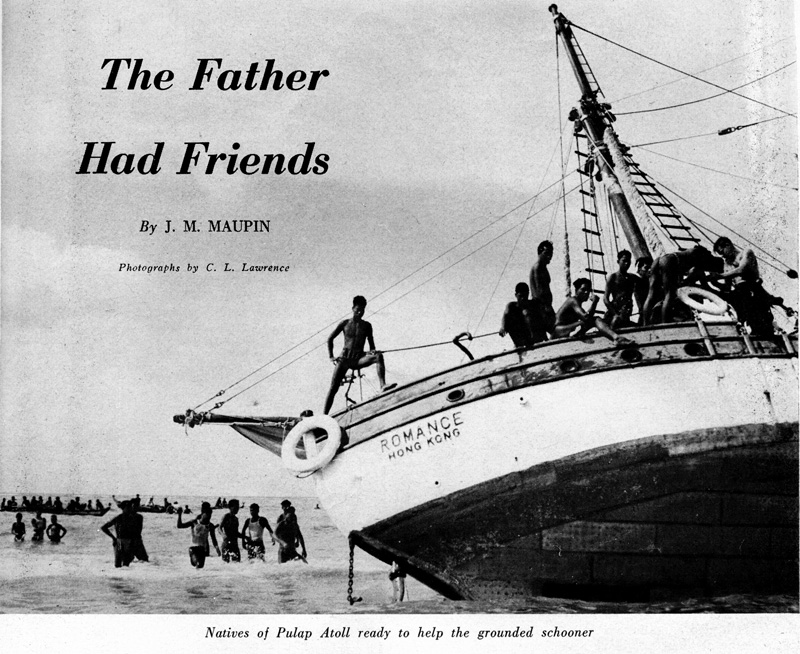
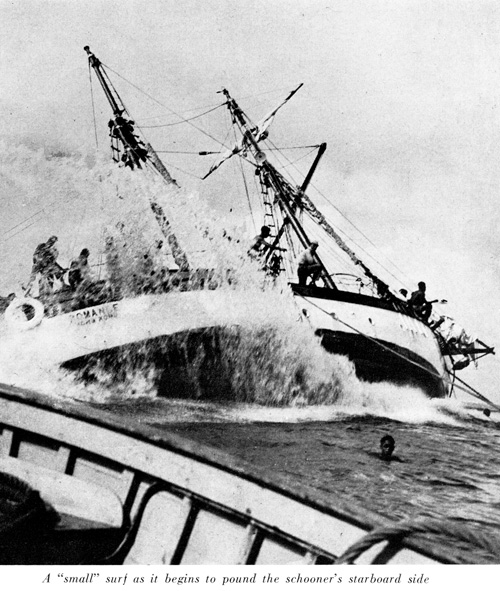
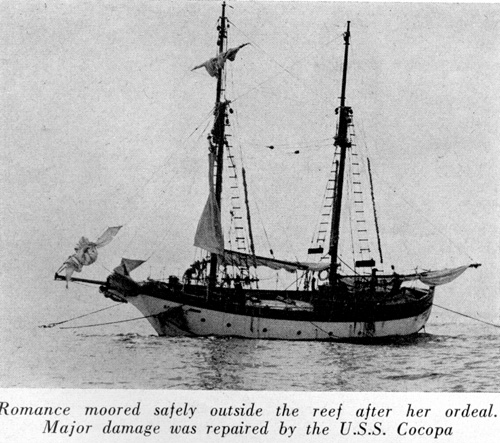
runs. On November 4, 1951, the. forty-five foot Hong Kong built schooner, at anchor off Pulap Atoll, was caught in a sudden storm, dragged anchor and in minutes had broached through the pounding surf and ridden high onto the coral reef where she hung poised on her side. The Romance was no ordinary vessel. She was known to every native in the far flung group and sailed among the many islands carrying medicine, news and friendship from her priest-captain, Father Rively, whose headquarters were the mission on the island of Truk. The natives called her the "preacher ship". Father Rively and his three man native crew were ashore on Pulap, a speck of land in the Micronesian group 460 miles southeast of Guam, when the blow struck. Helplessly they watched their trim ship lose her hold and crash aground, then they turned away. There was nothing they could do but wait and pray for calmer weather. That evening the wind quieted a bit and Father Rively and some of the natives waded out to the stricken ship to see the damage. Miraculously there was little. The jagged coral spikes had not yet pierced her side and her rigging was not badly damaged, but the danger increased with every hour as the surf continued to pound her seaward side and work her farther onto the reef.
Aboard the priest's small radio transmitter was soaked and shortcircuited and later he found that his auxiliary engine was of no use. The propeller and shaft were badly bent by the grounding. He was without means of communication, had no power and no help except that of his friends the natives who, laboring for hours, cut and floated coconut logs out to the Romance, working them under the keel and where possible between the ship's side and the reef, ft was tricky, backbreaking, dangerous work, but the logs cushioned the Romance from the reef, and if anything could pull her off they would make a small way along which she could slide until clear of the reef. There was nothing more they could do. A week passed and on the morning of November 11 the Romance was sighted by a Navy PBM on a routine patrol flight out of Guam. The pilot shot a message to the commander of naval forces in the Marianas, Rear Admiral E. W. Litch, and operations dispatched the fleet tug Cocopa to the scene at "best possible speed". The tug was under way in an hour and after a high speed run reached the schooner on the morning of November 13. The sea had slackened some since the grounding but rescue conditions were far from ideal.
Rescues were routine to drawling cheerful Lieutenant Commander R. C. Shannon, skipper of the Cocopa, but this one offered a set of unique problems. He had to maneuver his tug (one of the world's largest) close enough inshore to be effective, mindful of the powerful surge of the surf and of the sharpness with which the bottom shelved upward. He had to make himself understood by the natives and by the eager but not too sea-wise Father Rively. Another consideration was getting a towline to the Romance that was strong enough to pull her free yet light and flexible enough to be handled on the small schooner.
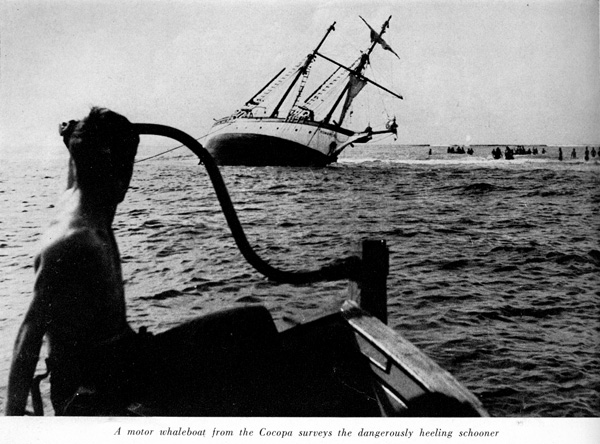
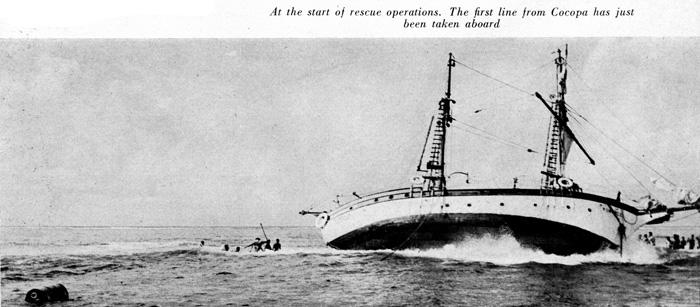
Shannon put over his motor whaleboat, sending a boatswain's mate and two men to the wreck to work with Father Rively and his natives in hooking up the towline. They found the Romance still sturdy though battered from the sea's constant punishment, hand and foot holds precarious and everything chillingly wet. Rively did not act like a man who had lost his ship, but was more like one who was saving it. The Cocopa shot out a small line connected to a larger one that was tied to a six inch manila hawser. The line did not reach the wreck but was caught by a wading native who walked it to the Romance and tied it to a fitting on the afterdeck. Then on a fifty gallon oil drum they floated a tougher one inch wire and tied it to another fitting on the schooner's deck. The Cocopa was ready to pull and it was none too soon. The wind and sea were picking up force and the Romance was heeling more and more. Father Rively encouraged the natives and helped the seamen, good natured and confident the Romance would be saved. The tug strained a little on the lines and steered a heading that would not wrench the Romance too sharply from her cradle on the reef, hoping to use the coconut log railway the natives had fashioned. As she pulled steadily the Romance, almost imperceptibly at first, began to move. She rolled, her masts came upright, and it was done. She was afloat. The natives on shore and in the water near the boat cheered and waved wildly. In safe water the Cocopa brought the schooner alongside to check her damage. A diver in shallow water gear went over the side to look at the hull and carpenters and ship fitters went to work on deck, repairing damage, replacing lines, fitting her out for the return voyage to Truk. Coffee and food supplies were put aboard. The coffee was in return for a cup Captain Shannon had, made by the priest, while inspecting the Romance. Shannon winced and tactfully pronounced it unusual. It is certain that Father Rively will never forget the Cocopa, and Shannon probably will always remember the coffee. When the work was done and the sailing vessel was seaworthy both ships headed for the open sea. Shannon gave Father Rively a course to Truk, some 150 miles distant, and with a final farewell the Cocopa, crackling out "mission completed" and an estimated time of arrival, headed for Guam.
Here the story should have ended, but the Romance, last seen bound for Truk under full canvas, was not yet out of the woods. She disappeared. For nineteen days she went unreported. The Navy had no knowledge of this because the mission on Truk made no mention of the Romance's failure to turn up, explaining later that the father was often late. Finally on the nineteenth day the Navy was told of the disappearance and in exactly forty-five minutes a Navy search PBM was in the air and all ships in the area were radioed to look for the Romance or her survivors. Six hours later the Romance, unharmed and unconcerned, sailed into Truk harbor and the search was called off. Over a can of cold beer at the mission Father Rively, puzzled and a little embarrassed at the trouble his ship had caused, told the story. Just an hour after parting from the Cocopa the wind fell and they were becalmed. His radio was out of commission, his auxiliary engine useless, and they were in trouble. They would need food and water soon as they could carry but a four day supply so they could only hope for land and wait for the wind. They prayed, he said, for both, and they got land, the wind coming nineteen days later. Asked what he had done for the nearly three weeks on the little island (name unknown), he said that he had helped the natives repair their chapel, delivered a baby and treated the sick. "Lots to do," he said. "They were all good friends of mine."
|
|
Este sitio es publicado por Histarmar - Argentina |
|
Direccion de e-mail: [email protected] |