Remember the whaleback
Steamers
Captain Alexander McDougall (1845-1924),
whose unconventional ideas enabled him to develop dozens of
patents in several different countries led to the creation of
the whaleback steamer.
McDougall envisioned a ship whose sleek,
steel hull would enable her to carry a maximum amount of cargo
at a minimum depth. The whaleback would also be a seaworthy
vessel with a low, rounded hull that minimized resistance from
fierce wind and waves Their rounded deck and turreted
superstructures were well adapted to heavy seas and allowed the
vessel to operate under such conditions without reducing
speed
Captain Alexander McDougall's concept for a
cheap, cylindrical hulled steamboat to carry bulk freight on the
Great Lakes initially met with great reluctance on the part of
Lakes shipbuilders. In 1887-1888, McDougall built his first
whaleback, barge 101 at the Robert Clark Shipyard in Duluth,
Minnesota. The 428-ton barge was 191 feet long and 21 feet in
beam. It had a cargo capacity of 1,200 tons. The 101's conoidal
bow and stern were fabricated at the Pusey & Jones
Shipbuilding Company of Wilmington, Delaware. The following
year, McDougall obtained financial backing from New York
interests and formed the American Steel Barge Company with a
yard in Duluth, Minnesota. The company launched two 253-foot
long barges in 1889. In 1890, McDougall built his first
whaleback steamer, the Colgate Hoyt, named for one of the
company's directors. The Hoyt cost $120,000, a little more than
twice the cost of a whaleback barge. It was reputed to travel at
16 miles per hour, surpassing many of the conventional steamers
of the day.
|
THE JOHN
ERICSSON AT THE HARBOUR WALL IN PORT COLBORNE ON
MARCH 29, 1938 |
The whaleback's simple design also was
cheap and easy to build. In 1893, the cost of operating one
whaleback freighter with two whaleback consorts was estimated at
$33.33 per ton. An
His whaleback, also known as a pigboat, was
a cigar-shaped vessel with conoidal ends and the superstructure
set above turrets mounted on the main deck. Nineteen whaleback
steamers, one passenger vessel, and 23 consorts were built by
McDougall between 1889 and 1898. The design influenced most
shipbuilding modifications introduced on the Great Lakes during
that period, including "turtlebacks," "monitors," and
"straightbacks... All but two of them were built at McDougall's
American Steel Barge Company in Superior,
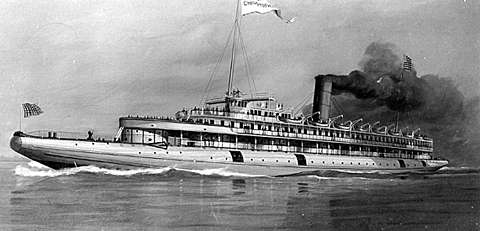
In 1893, McDougall built his only passenger
whaleback, the Christopher Columbus. The Columbus was built to
carry passengers from Chicago to the World's Fair
The whalebacks became obsolete when their
design proved incapable of adapting to developments in cargo
handling machinery
The only surviving whaleback The S.S.
Meteor, formerly the Frank Rockefeller, was converted into a
tanker in 1943. It was retired from service in 1969, purchased
by the city of Superior in 1972 and set on Bakers Island in the
Superior Harbor in 1973 as a museum vessel.
Christopher Columbus
Whaleback passenger steamer (1f). L/B/D: 362 × 42
× 24 dph (110.3m × 12.8m × 7.3m). Tons: 1,511 grt. Hull: steel.
Comp.: 5,000 pass. Mach.: triple expansion, 3,040 hp, 1 screw;
18 kts. Des.: Alexander McDougall. Built: American Steel Barge
Co., West Superior, Wisc.; 1893.
The world's only whaleback passenger
vessel, Christopher Columbus was built for the Chicago World's
Fair commemorating the quadricentennial of her namesake's
transatlantic voyage in 1492. The intent of her designer,
Alexander McDougall, was to publicize his radical new whaleback
hull design. The whaleback was so called because with its
rounded deck and conoidal bow, which offered little resistance
to the elements, the hull resembled a breaching whale. Observers
looking at them head-on called them pig boats. Built with four
decks—a fifth was added later—Christopher Columbus carried
nearly two million passengers on the six-mile run between
Randolph Street in downtown Chicago and the exposition grounds
at Jackson Park. When the fair ended, she was acquired by the
Hurson Line for the 170-mile passenger run between Chicago and
Milwaukee. Sold to the Goodrich Transit Company in 1909, in
1932-33 she was featured at the Century of Progress exhibition
in Chicago. It is estimated that in her forty-four years of
service, she carried more passengers than any other Great Lakes
passenger vessel ever built before being broken up by the
Manitowoc Shipbuilding Company in 1936. Although more than forty
whalebacks were built—including the Meteor, preserved in
Superior, Wisconsin—McDougall's concept never gained widespread
acceptance.
Wilterding, McDougall's Dream. Inkster,
"McDougall's Whalebacks.
"Christoper Columbus," 1893. Captain Alex McDougall
American Steam Barge Co. Superior, WI Lot 1487
More information is avaiable on the following Web
Sites
Wisconsin Stories
Wisconsin Historical
Society