


 |
|||||||||||
 |
 |
||||||||||
 |
|||||||||||
 |
|||||||||||
 |
 |
||||||||||
Laboratory Set-Upand Polymer Documentation |
||||||||||
|
Experimentation conducted on
the development of Passivation Polymers has required the use of sophisticated
laboratory equipment. The intent of this disc, however, has been to devise
some basic processes that can be implemented without the need for elaborate
technology. While there is no one ideal set-up for a functional lab, layout
and location of equipment and materials should always adhere to guidelines
established by reputable agencies such as the Occupational Safety and
Health Administration (OSHA). Worldwide, a number of agencies act in the
interest of promoting laboratory safety. Many of these have Web-accessed
resources available, free of charge. Although safety was a major consideration in choosing material for the development of Passivation Polymer technologies, many of the materials we suggest using in the laboratory require proper handling and storage. All technicians working in a chemistry lab need to be familiar with proper procedures for handling and disposing of chemicals. A complete inventory of chemicals should always be kept in case of an emergency, and Material Safety Data Sheets (MSDS) for chemicals used in the facility must be available for immediate consultation. In the event of an emergency, the MSDS catalog contains vital contact information as well as important instructions if medical assistance is needed. |
||||||||||
 |
||||||||||
|
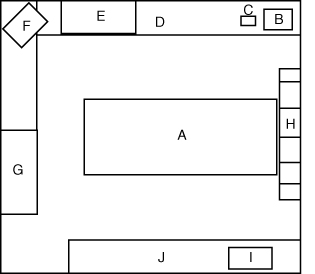
Figure 1. A functional research/working laboratory. (A) Double-sided workbench; (B) sink; (C) eye wash system; (D) under cabinet flammable liquid storage; (E) vented fume hood; (F) vented warming oven; (G) explosion-proof freezer. |
||||||||||