Parte 1 - San
Francisco
Lo primero que se me viene a la mente
es: Carisimo!. Pero San Francisco tiene un alma propia que no tiene
precio. Conserva intacta su identidad. Estuvimos alli con mi esposa
Monica por unos cortos días, que alcanzo bien para cubrir todas sus
bellezas, desde la hermosa bahia y sus paisajes hasta Chinatown y los
cablecars. Pero lo que nos trae aqui es la Historia Maritima, de la
cual rebosa. L vista desde la ciudad es de un movimiento continuo,
inmensos buques portacontenedores, petroleros, barcazas, veleros,
buques de guerra, pesqueros, ferries... todos se cruzan y entrecruzan
en medio de las fuertes corrientes de la Bahia. Durante la obligada
niebla de la mañana y de la tarde sigue el mismo movimiento, esta vez
apuntado por toques de sirena de todo tipo. Todo un concierto
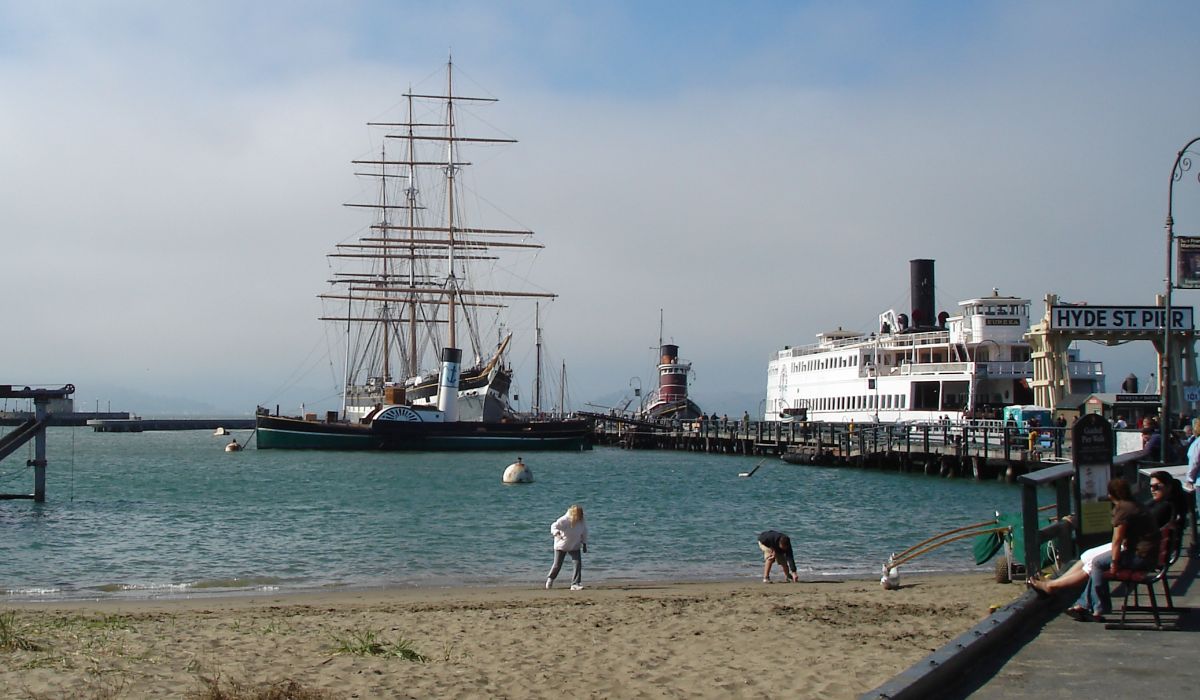
Pero en tierra el punto central es sin
duda Fisherman´s Wharf, o el Muelle de Pescadores. El antiguo muelle
ha sido convertido ahora en un shopping center (lindo, pero irreal),
pero en su derredor aun estan los stands de venta de cangrejos y
langostinos, tal como hace 50 años. En el medio de los muelles esta
la entrada al Parque Nacional Maritimo de San Francisco, una
verdadera Joya.
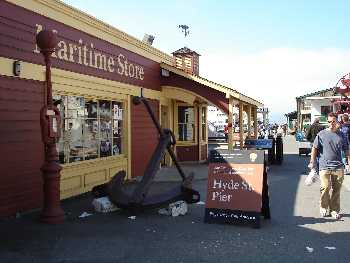
Por supuesto lo primero, siempre, es el
negocio de recuerdos, pero en este caso gerenciado por expertos, ya
que sus libros y elementos son autenticos tesoros; uno se compraria
todo, pero aca viene lo primero que dije, los precios!. Asi que
seguimos caminando a duras penas por lo que uno no puede
llevarse.
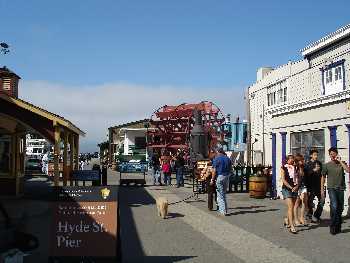
Aparte de elementos interesantes como una
rueda de paletas, maquinas de vapor y otras cosas por el estilo, lo
importante de este Parque son sus naves( y hacerse una corrida para
tocar las frias aguas del Pacifico, por supuesto).
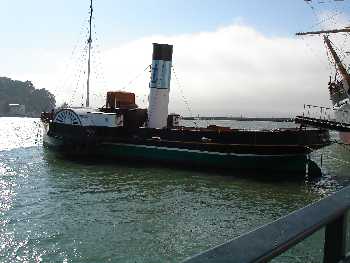
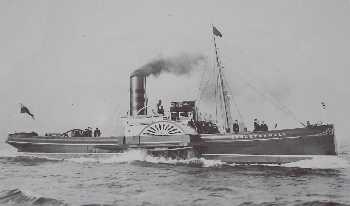
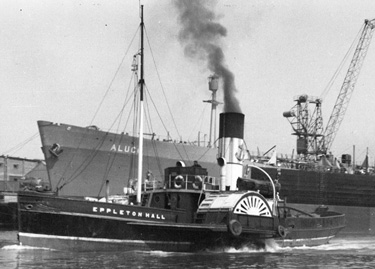
Primero esta el remolcador a vapor de
paletas laterales Eppleton Hall, construido en 1914 en South Shields,
Inglaterra. Opero alli, en el Rio Wear hasta 1968, luego fue llevado
por su propia propulsion hasta San Francisco. Es el unico ejemplo de
remolcadores de este tipo que sobrevive. Esta aun en restauracion. Su
informacion dice:
| |
Eppleton Hall
was built in 1914 by the Hepple and
Company of South Shields, England, for
the Lambton and Hetton Collieries, Ltd.
The vessel, named after the Lambton
family's ancestral home, was designed to
tow ocean-going colliers (coal-carrying
vessels) to and from the port of
Newcastle on the River Tyne. Coal was a
booming business, and days of transit
time were saved by towing the sailing
vessels upriver to load. The vessel was
also used to tow newly-built ships out
to sea.
Eppleton Hall,
a
steam sidewheeler with side-lever
engines, is the only remaining intact
example of a Tyne paddle tug. A direct
descendent of the first craft to go into
commercial service as harbor tugs, the
vessel was engaged on the Wear and Tyne
rivers of northeast England from
1914-1967. In 1946, she was purchased by
France Fenwick, Wear and Tyne Ltd.,
which operated her in the Wear River
until 1964 (she is being restored to
this period today).
The
Eppleton Hall's
steam engines are descended from a type
first developed in England in 1828. The
two large side lever engines, often
referred to as grasshopper engines,
operate the paddle wheels independently,
making the tug especially maneuverable
in tight spots.
Another
unusual feature of the Eppleton Hall are
its hand-forged boilers designed to use
seawater. Every six weeks the
accumulated salt had to be chiped out of
the boilers and rinsed away. The
advantage was that large freshwater
tanks did not have to carried aboard.
In 1952, the tug was modified slightly
to obtain a Passenger Certificate, so
that she could transport officials from
newly-launched steamers. Her last
commerial owner was the Seaham Harbour
Dock Board, which operated her from 1964
to 1967.
She was
sold for scrap in 1967 and, while
sitting on a mud bank, fire, (part of
the scrapping process) destroyed her
wooden afterdeck and interior. From
1969-1979
Eppleton Hall
served as a private yacht, during which
time she was modified for an epic steam
(via the Panama Canal) to San Francisco,
passing through the Golden Gate in
March of 1970.
The vessel was donated to the National
Park Service in 1979. She is now berthed
at Hyde Street Pier.
|
|
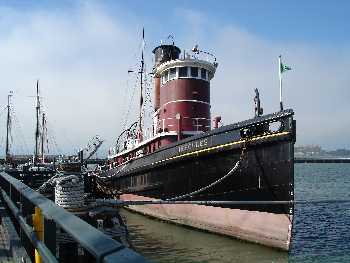
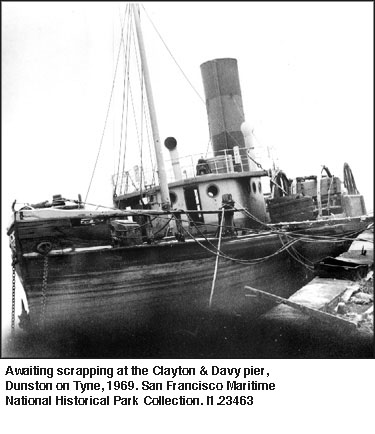
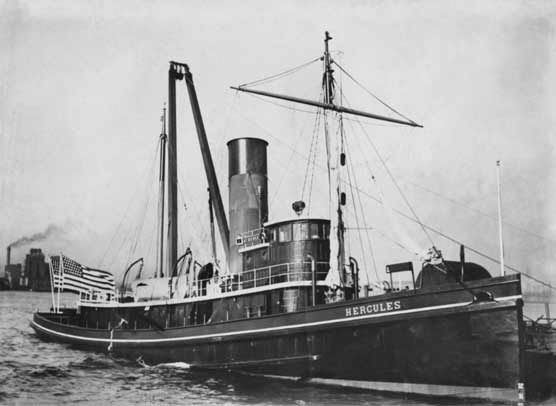
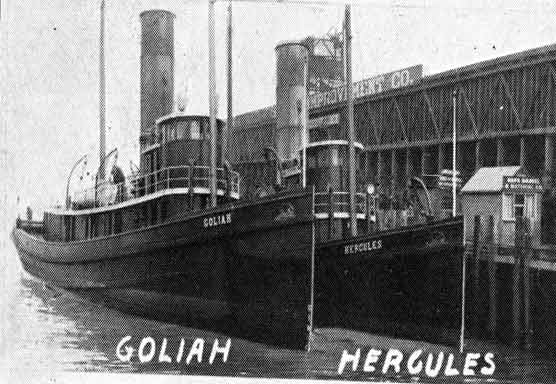
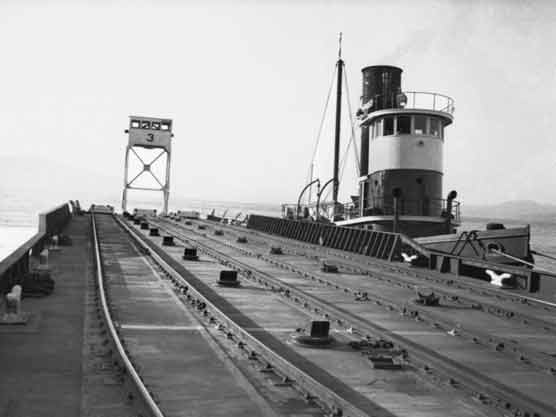
Muy cerca esta el Hercules, tambien a
vapor, construido en Camden, New Jersey en 1907, de 409 TRB. Su
primer viaje fue de 13.500 millas nauticas, llevando a tiro a su
gemelo el Goliath, cruzando el Cabo de Hornos. Hasta 1923 opero en la
costa del Pacifico, desde Alaska hasta Panama, llevando barcazas,
buques y balsas de maderas. Luego opero en la Bahia de San Francisco
desde 1924 a 1962, tirando de barcazas para el ferrocarril. Su fuerte
casco de acero y confiable motor de triple expansion le dieron una
larga vida. Esta aun en condiciones operativas. Su historia
dice:
Long
Tows on the Open Ocean
John H. Dialogue and Son, of Camden,
New Jersey, built
Hercules in 1907.
She had been ordered by the San
Francisco-based Shipowners’ and
Merchants’ Tugboat Company, to join
their Red Stack fleet (named for
their red-painted smoke stacks).
When completed,
Hercules towed her
sister ship, the
Goliah, through the
Strait of Magellan to San Francisco.
Both vessels were oil-burners;
Goliah carried fuel,
water and supplies for her sister.
Hercules
towed barges, sailing ships and log
rafts between Pacific ports. Because
prevailing north-west winds
generally made travel up the coast
by sail both difficult and
circuitous, tugs often towed large
sailing vessels to points north of
San Francisco. In 1916,
Hercules towed the
(another of San
Francisco Maritime National
Historical Park’s historic fleet) to
Port Townsend, Washington. The trip
took six days. She also towed the
Falls of Clyde, now a
museum ship in Hawaii.
On trips back down the coast,
Hercules often towed
huge log rafts, laden with
millions of board feet of Northwest
timber, to Southern California mills.
At other times,
Hercules towed barges of
bulk cargoes between other West
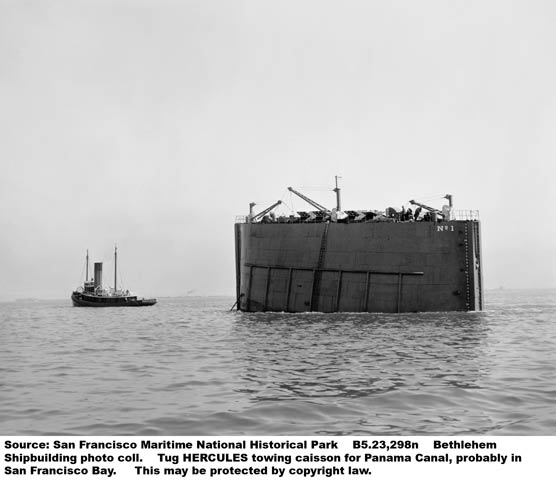
Coast Ports, and to Hawaii. During
the construction of the Panama
Canal, she towed a huge floating
caisson (a steel structure used
for closing the entrance to locks)
to the Canal Zone.
In her deep-sea days,
Hercules usually carried
a
crew of fifteen-enough manpower
for her Engine Department to stand
three watches while underway. The
deep, narrow hull made life
uncomfortable at times, because it
rode low in the water, and the main
deck was often awash. However, the
food was good and, for an
experienced hand, the work was
steady. Tugboat captains were
generally well-paid and highly
respected, for it took considerable
experience to bring a tug and a
heavy tow through high seas in bad
weather--and good judgment to
navigate the shallow bars and narrow
entrances of West Coast ports.
Bay Tug
Hercules was
eventually acquired by the Western
Pacific Railroad Company. Her career
changed significantly; she no longer
served as an ocean-going tug, but
shuttled railroad car barges
back and forth across San Francisco
Bay. She worked until 1962, when
changing transportation patterns
(the decline of the railroads) and
the introduction of diesel-powered
tugs sealed her fate.
Restoration
Hercules
avoided the scrap yard, but
languished until the California
State Park Foundation acquired her
for the San Francisco Maritime State
Historic Park, in 1975. The National
Park Service took over the task of
her restoration in 1977, and in 1986
she was designated a National
Historic Landmark.
Hercules has been
as part of the
Historic American Engineering
Record's
.
"Out through the
Golden Gate, the most beautiful
harbor in the world. North,
towing this barkentine to
Port Washington
in
Canada. Thence south, empty, to
Astoria
where we picked up six million
feet of timber in a raft to tow
south to
San Diego. Long, slow, lazy
days, making no more than three
knots. Even the patent log [a
device trailed in the water to
measure speed] would not work.
We rigged a fishing line on it
and caught beautiful king salmon
on the way."
Albert J. Hody, fireman, describing
life aboard
Hercules in 1919.
Excerpted from an oral history in
the Park's collection
Goleta ALMA
Alma History
Fred Siemer came to San Francisco
from Germany in 1865, and started
his own shipyard at Hunters Point (located
in the southeastern section of San
Francisco).
He constructed two scow schooners.
Siemer named the first after his
daughter, Adelia. After Adelia
married, Siemer built the second
scow for his son-in-law, James
Peterson. That boat, constructed in
Peterson’s front yard in 1891, was
named for Peterson’s daughter, Alma.
Alma’s construction was
not unique, but it was unusual; her
bottom planking was laid
athwartships (side-to-side) instead
of fore-and-aft. Called "log built"
because the horizontally-laid planks
were quite thick, scows like
Alma traded a bit of speed and
ease-of-repair for economy and
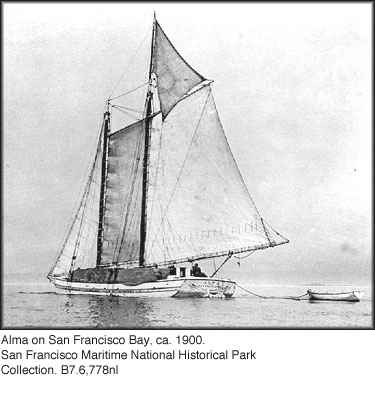
strength. This
photo of Alma underway on San
Francisco Bay dates from about 1900.
Alma hauled a wide
variety of cargoes during her career.
She carried hay and lumber under
sail, and after Peterson removed her
masts in 1918, she freighted sacks
of Alviso salt while being towed as
a barge. Frank Resech, who purchased
the vessel in 1926, installed a
gasoline engine in her, and from
then until 1957 her cargo was
exclusively oyster shell – carried
in a 22’ by 36’ wooden bin installed
on deck.
A number of sailing scows ended
up as oyster shell dredges. The
shell was free for the taking and
vast deposits lay in the San
Francisco Bay. Both Resech and his
wife lived and worked aboard
Alma for a time; Mrs. Resech
handled the steering while her
husband operated the dredging
machinery. During those days,
Alma hauled 110-125 tons of
shell per week to Petaluma,
California, where it was ground and
used for chicken feed.
In 1943, Resech sold the vessel
to Peter John Gambetta, who
continued to operate her as a
dredger until 1957. When Gambetta
retired Alma she was still
seaworthy, but no longer profitable.
The State of California purchased
Alma as she lay on the
Alviso mudflats in 1959, and
restoration work began in 1964. She
was transferred to the National Park
Service in 1978, and designated a
National Historic Landmark in
1988.
Alma is now part of the
San Francisco Maritime National
Historical Park’s fleet of historic
vessels at Hyde Street Pier. She
sails every season, and
participates in the revived Master
Mariners Regatta every May.
| |
 |
History of Scow Schooners on San
Francisco Bay
Between 1850 and the early years
of the 20th century, the best
highways around the San Francisco
Bay Area were the waterways, and the
delivery trucks and tractor-trailer
rigs of those days were the
flat-bottomed scow schooners. Over
400 of these craft were constructed
around the Bay. And although similar
vessels were to be found in New
England and on the shores of the
Great Lakes, the basic "scow" design
was adapted to local conditions,
resulting in a craft uniquely suited
to San Francisco Bay.
Able to navigate the
Sacramento/San Jaoquin Delta
region’s shallow creeks, sloughs and
channels, the scows’ strong, sturdy
hulls could rest safely and securely
on the bottom – providing a flat,
stable platform for loading and
unloading. Their squared bows and
sterns not only maximized cargo
space, but also make scows cheap and
easy to build. Typically constructed
of inexpensive Douglas fir, their
design was so simple that most scows
were built "by eye" – without plans
of any kind.
Nicknamed "hay scows," it was
common to see dozens of these small
craft crowding San Francisco’s Hay
Wharf each day of the April-October
season. With deckloads of 600-700
bales, the scows had to "reef up"
their sails to raise the booms over
six tiers of hay.
The wheel, too, was raised high
above the deck so that the helmsman,
standing aft on the "pulpit," could
see to steer.
But scows hauled much more than
hay. Until the 1870s, they carried
Mt. Diablo coal to San Francisco;
later, scows distributed English and
Australian coal upriver. After the
1906 earthquake, the small boats
freighted tons of still-warm brick
from East and South Bay kilns to
rebuild the City. Oregon lumber was
always a common upriver cargo, and
the boats hauled potatoes, onions
and grain from the inland valleys to
the Bay. Scows also transported
gravel, sand, salt and fertilizer.
Although scow schooners (like
their masters) were sturdy and
hardworking, they also found time to
relax. Scow owners traditionally
sailed their boats to Paradise Cove
(in MarinCounty) for family picnics
in the spring. And the wide-decked
craft were so often rented-out for
evenings of dancing (and drinking)
on the Bay that schoonermen had a
special name for such excursions –
they called them "drownding parties."
Reasonably priced, small and
maneuverable enough for two or three
men to operate, scows lured many
enterprising salt-water sailors from
the sea. Compared to their sea-going
contemporaries, "tule sailors" (as
scow schoonermen were called) lived
very well indeed. A berth on
deepwater square-rigger brought $25
a month and salt-pork; "tule sailors"
earned double that, and ate steak
and farm-fresh vegetables besides.
Progress, in the form of gasoline
engines, doomed these hearty sailing
vessels, however. The last sailing
scow schooner was built in 1906, and
by the 1920s most scows had been
rigged down to one mast. Some
continued to work as barges or
oystershell dredges. But in 1957,
improved highways and motorized
trucks squeezed even Alma,
the last survivor, out of
profitability.
|
|
|
| |
|
|
History
| The ferryboat Eureka, built in 1890. |
|
| STATS |
|
| Overall length |
299.5 feet |
| Extreme Width |
78 feet |
| Gross tonnage |
2420 |
| Horsepower |
1500 |
| Passengers |
2300 |
| Automobiles |
120 |
- Eureka is a wooden-hulled, sidewheel paddle steamboat.
- From the passenger deck up, she is nearly identical fore and aft. Her "double-end" design made disembarking quicker and easier.
- Eureka's large, "walking beam" steam engine remains intact.
|
|
|
Eureka was built in
1890, at Tiburon, California, for
the San Francisco and North Pacific
Railway (and named Ukiah to
commemorate SF&NPR's recent rail
extension into that California city).
A freight-car ferry, Ukiah was SF&NPR's
"tracks across the Bay," ferrying
trains from Sausalito to San
Francisco.
After WWI, Ukiah needed
extensive repair, and shipwrights at
the Southern Pacific yard labored
for two years - eventually replacing
all of her structure above the
waterline. This kind of
reconstruction was called "jacking
up the whistle and sliding a new
boat underneath."
Re-christened Eureka, the
vessel was launched from the
Southern Pacific yard as a passenger
and automobile ferry (her present
form) in 1923.
Steam Ferryboats on San Francisco
Bay
The Bay's first steam ferry (the
tiny Sitka) arrived in
1847, stowed aboard a Russian cargo
ship. But the ferry, Kangaroo,
made the first regularly scheduled
crossings in 1850.
After Mexico ceded California to the
United States in 1848 (and John
Marshall discovered gold in the
American River) the Bay Area's
population exploded. It is said that
San Francisco's Ferry Building was
once second only to London's Charing
Cross Railway Station as the busiest
passenger terminal in the world. At
one time, Southern Pacific Railroad
operated forty-two ferryboats on the
Bay (they transported 50,000,000
passengers per year). Construction
of the Bay and Golden Gate bridges (mid
1930s) signaled the end of the
ferryboat era, however.
In 1941, Eureka had the
dubious distinction of making the
last Marin County run, and by the
1950s regular ferry service was
limited to railroad connections.
Eureka kept working, but in
1957, when her crankpin snapped in
mid-crossing, she was removed from
service. Just one year later, the
San Leandro made the last transbay
ferryboat run.
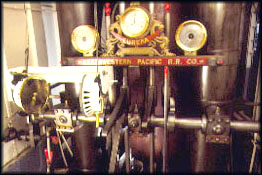
|
|
The
engineer's
platform
on the
Eureka. |
|
| |
|
The Walking Beam
Engine
Eureka's
tall "walking beam"
is the last working
example of an
engine-type once
common on America's
waterways.
Manufactured by
Fulton Iron Works of
San Francisco, this
engine remains
unaltered to this
day.
Oil was burned in
boilers to produce
the steam, which
drove a huge,
vertical piston.
Perched atop the
engine, the walking
beam changed this
up-and-down motion
into rotary motion
via a connecting rod
linked directly to
the paddlewheel
shaft.
The twin
paddlewheels (each
twenty-seven feet in
diameter) made
twenty-four
revolutions per
minute.
|
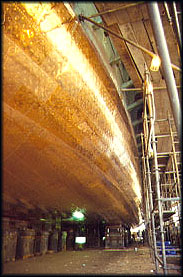
|
|
A view
of
Eureka's
hull
when she
was out
of the
water in
a
drydock
facility. |
|
| |
|
Restoration
In February of 1994,
Eureka
exited San Francisco
Drydock after a $2.7
million restoration
project. The
steamship had been
in the shipyard
since October, where
a crew of 45 skilled
craftsmen caulked
2.5 miles of
planking seams, and
hammered in over
9000 eight-inch
spikes. They applied
stockholm tar, laid
Irish Felt, and then
plated the hull with
12,000 square feet
of shining copper (cut
down from modern
dimensions to
traditional-sized
pieces to maintain
the historical
facade).
The vessel had
suffered from rot in
the edges of her
main deck, and the
caulking between her
four-inch thick hull
planks had softened.
The immense beams
holding up her
paddle wheels and
paddle boxes had
deteriorated, and
were replaced with
steel. The
overhanging ends and
sides of the ferry
were also repaired.
To prevent the
recurrence of rot,
borate rods have
been installed in
all the new timbers.
This is cutting edge
preservation
technology,
pioneered by the
park to treat its
other ships. Over
time, rainwater
intrusion (a primary
cause of dry rot)
causes the rods to
dissolve, and the
borate leaches out
into the wood,
preventing rot from
taking hold.
In October of
1999, Eureka
entered San
Francisco Drydock
for a $1 million
restoration project
focusing on the
vessel’s
superstructure --
the above-water
portions of the
vessel. A
significant portion
of that drydock was
the replacement of
the boat’s "kingposts"
-- four large wooden
structures which
support the
paddlewheels and
upper decks.
|
|
|
|
|
The lumber schooner,
C.A. Thayer, built
in 1895. |
|
| STATS |
|
| Extreme
Length |
219 feet |
| Length on
Deck |
156 feet |
| Beam |
36 feet |
| Depth |
11.38 feet |
| Gross
tonnage |
453 |
| Height of
mainmast |
105 feet |
- The CA Thayer is a wooden-hulled,
three-masted schooner, designed
for carrying lumber.
- She was built in 1895 in
Northern California at Hans D.
Bendixsen’s shipyard in
Fairhaven, CA.
- The original hull was made
of dense, old-growth Douglas fir
carefully chosen for
shipbuilding.
- She sailed with a small crew
consisting of four seamen, two
mates, a cook, and the captain.
Once, hundreds of sailing
schooners carried lumber to San
Francisco from Washington, Oregon and
the California redwood Coast. Built
in 1895, C.A. Thayer was
once part of that mighty Pacific
Coast fleet. Today, she is a rare
survivor from the days when strong
canvas sails billowed over tall
deckloads of freshly-milled fir and
redwood.
|
|
|
Lumber
SchoonerIn 1895,
Danish-born Hans D. Bendixsen built
C.A. Thayer in his Northern
California shipyard (located across
the narrows of Humboldt Bay from the
city of Eureka). She was named for
Clarence A. Thayer, a partner in the
San Francisco-based E.K. Wood Lumber
Company.
Between 1895 and 1912, Thayer
usually sailed from E.K. Wood's mill
in Grays Harbor, Washington, to San
Francisco. But she also carried
lumber as far south as Mexico, and
occasionally even ventured offshore
to Hawaii and Fiji.
Thayer is fairly typical
of West Coast, three-masted lumber
schooners in size (219' extreme) and
cargo capacity (575,000 board feet).
She carried about half of her load
below; the remaining lumber was
stacked ten feet high on deck, and
secured with chain (as illustrated
in this 1912
). In port, her small crew
(eight or nine men) served double-duty
as longshoremen; unloading 75,000 to
80,000 board feet was an average
day's work.
After sustaining serious damage
during a heavy, southeasterly gale,
C.A. Thayer's lumber trade
days ended in an Oakland shipyard,
in 1912. But it was really the rise
of steam power, and not the wind,
that pushed her into a new career.
Salt-Salmon Trade
Early each April from 1912 to
1924, C.A. Thayer hauled
28-foot gill-net boats, bundles of
barrel staves, and tons of salt from
San Francisco to Western Alaska.
This
shows her underway, in
1914. She spent the summer anchored
out at Squaw Creek (see
) or Koggiung; the
fishermen worked their nets and the
cannery workers packed the catch on
shore. Thayer then returned
each September, her hold stacked
with barrels of salted salmon.
Vessels in the salt-salmon trade
usually laid up during the winter
months, but when World War I
inflated freight rates (1915-1919),
C.A. Thayer carried
Northwest fir and Mendocino redwood
to Australia. These off-season
voyages took about two months each
way. Her return cargo was usually
coal, but sometimes hardwood or
copra (dried coconut meat, from
which coconut oil is pressed).
Codfisherman
From 1925-1930, C.A. Thayer
made yearly voyages from Poulsbo,
Washington, to the Bering Sea
codfishing waters (off the Alaskan
coast). In addition to supplies, she
carried upwards of thirty men north,
including fourteen fishermen and
twelve "dressers" (the men who
cleaned and cured the catch).
At about 4:30am each day, the
fishermen launched their Grand Banks
dories over Thayer's rails,
and then fished standing up, with
handlines dropped over both sides of
their small boats. When the fishing
was good, a man might catch 300-350
cod in a five-hour period.
After a decade-long,
Depression-era lay-up in LakeUnion,
Seattle, the U.S. Army purchased
C.A. Thayer from J.E. Shields
(a prominent Seattle codfisherman)
for use in the war effort. In 1942,
the Army removed her masts and used
Thayer as an ammunition barge in
British Columbia. After World War
II, Shields bought his ship back
from the Army, fitted her with masts
once again, and returned her to
codfishing. This bustling
(ca. 1946-50,
P9,8493.) illustrates her post-WWII
period.
With her final voyage, in 1950,
C.A. Thayer entered the
history books as the last commercial
sailing vessel to operate on the
West Coast.
Restoration
The State of California purchased
C.A. Thayer in 1957. After
preliminary
in Seattle,
Washington, an intrepid volunteer
crew sailed her down the coast to
San Francisco. The San
FranciscoMaritimeMuseum performed
more extensive
and refitting, and
opened Thayer to the public
in 1963. The vessel was transferred
to the National Park Service in
1978, and designated a National
Historic Landmark in 1984. After
three full careers, and over 100
hundred years, she remains --
restored and maintained for future
generations -- to be experienced at
the San Francisco Maritime National
Historical Park.
The
Lumber Trade
As late as the California Gold
Rush, East Coast vessels still
hauled New England lumber 13,000
miles around Cape Horn to San
Francisco. But that soon changed.
Captain Stephen Smith (of the bark
George Henry) established the first
PacificCoast lumber mill in a
redwood forest near Bodega,
California, in 1843. And by the
mid-1880s, more than 400 mills
operated in California's Humboldt
forest region alone.
At first, lumbermen shipped their
planks to market in old East Coast
square-riggers. But these aging
ships were inefficient -- they were
hard to load and required a large
crew to operate. The booming lumber
industry needed specialized vessels,
and it wasn't long before shipyards
sprang up to supply them.
Hans Bendixsen opened one such
yard at Fairhaven, California, in
1865. Bendixsen built many vessels
for the lumber trade; in addition to
C.A. Thayer he constructed
ninety-two sailing vessels between
1869 and 1901 -- thirty-five of them
three-masters.
Sailing lumber schooners were
built of the same Douglas fir as the
planks they carried. They had
shallow drafts (for crossing coastal
bars), uncluttered deck arrangements
(for ease of loading), and were
especially handy (for maneuvering
into the tiny, Northern California
ports called "dog-holes").
Many West Coast lumber schooners
shared another feature: they were
rigged "baldheaded"-- without a
topmast. This rig simplified tacking
into the strong westerlies when
bound north. They did carry topsails,
set on the "pole" sections of the
mast, but the sails were much
smaller and easier to handle than on
the standard topmast rig. Most of
the work on the topsails could be
done from the deck.
Even though lumber schooner crews
had to load and unload their own
cargo, most sailors preferred a "coastwise"
berth to going "deepwater." At $30 a
month ($40 for the man who ran the
steam-donkey engine), the pay was
good. And the coastwise ships had a
reputation for being "good feeders"
(serving good food, and plenty of it).
Lumber schooner crews, unlike those
of deepwatermen, often stayed
together for many voyages.
Inevitably, progress overcame the
sailing ships. Steam-powered
schooners proved more dependable and
cost effective. Although sailing
vessels like C.A. Thayer
competed with steamers (and railroad
boxcars) well into the 20th-century,
the last sailing schooner
commissioned for the lumber trade
slid down the ways in 1905.
|
|
|
http://www.nps.gov/safr/historyculture/thayerrestoration.htm?eid=151089&root_aId=276#e_151089
(restauracion)
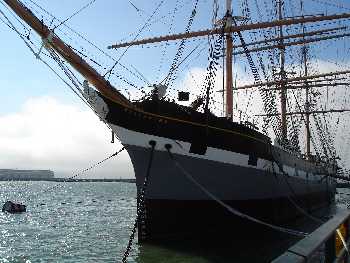
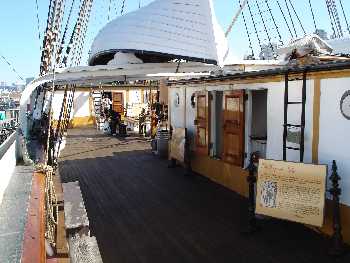
La estrella es sin dudas el Balclutha,
que fuera luego el Star of Alaska. Esta en prístina condicion. El
Balclutha era uno de los miles de veleros de hierro y acero
construidos en Gran Bretaña y Europa a partir de la decada de 1860.
Fue construido por Charles Connell en Glasgow en 1886, con una eslora
de 256 pies, manga de 38 y 1689 toneladas brutas. Durante 13 años,
bajo bandera britanica, navego entre Europa y San Francisco trayendo
carbon y mercaderias, y llevando de regreso cereales, tocando cinco
veces este puerto. De 1903 a 1930 hizo viajes entre San Francisco y
Alaska, rebautizado Star of Alaska, llevando hombres y mercaderias a
las empacadoras y trayendo salmon enlatado de regreso. Fue comprado
en 1933 por Frank Kissinger y rebautizado Pacific Queen; lo uso para
excursiones como "buque pirata", anclado en la isla Catalina fue
usado como escenario para filmar "El Botin del Bounty" (con Clark
Gable y Charles Laughton). Se fue deteriorando lentamente y se salvo
por un pelo del desguace durante la 2ª GM. En 1954 el Museo Maritimo
de San francisco lo compro por u$s 25.000 y ayudado por donaciones y
la comunidad, fue posible restaurarlo y retornarlo a su nombre
original. Es desde 1978 Patrimonio Historico Nacional.
|
STATS |
|
|
Overall length |
301
feet |
|
Length
of deck |
256.5
feet |
|
Beam |
38.6
feet |
|
Depth |
22.7
feet |
|
Gross
tonnage |
1689 |
|
Height
of mainmast |
145
feet |
- Balclutha is a
three-masted, steel-hulled,
square-rigged ship built to
carry a variety of cargo all
over the world.
- Launched in 1886 by the
Charles Connell and Company
shipyard near Glasgow, Scotland,
the ship carried goods around
Cape Horn (tip of South America)
17 times.
- It took a crew of about 26
men to handle the ship at sea
with her complex rigging and 25
sails.
| |
|
|
CareersBritish Deepwaterman
On January 15, 1887, with a twenty-six-man crew, Balclutha sailed under British registry from Cardiff, Wales, on her maiden voyage. She was bound for San Francisco. The ship entered the Golden Gate after 140 days at sea, unloaded her cargo of 2,650 tons of coal, and took on sacks of California wheat. This , ringed by portraits of Captain Constable and his crew, was taken on San FranciscoBay in June, 1887.
Because of the months-long ocean voyage, Balclutha made only one round-trip per year while engaged in the Europe-to-San Francisco grain trade. She arrived with a cargo three times, but also brought pottery, cutlery, Scotch whisky (from Glasgow and Liverpool) and "Swansea general" (tinplate, coke and pig iron) to San Francisco.
During the mid-1890s the ship called at other ports around the world; in New Zealand, for example, she loaded wool and tallow for London, England.
In 1899 Balclutha was transferred to Hawaiian registry, and she joined the bustling Pacific Coast lumber trade. For three years the ship sailed north to Puget Sound, Washington, and then across to Australia. Much of the 1.5 million board feet she could carry ended up underground, used for mining timbers in the Broken Hill Mine at Port Pirie, Australia.
Balclutha was the last vessel to fly the flag of the Hawaiian Kingdom. In 1901 a special act of the United States Congress admitted the ship to American registry so that she could engage in "coastwise" trade (i.e. between American ports). Soon thereafter, the Alaska Packers Association, a San Francisco firm which harvested and canned salmon, chartered her to carry men and supplies north – to Alaska.
Salmon Packet
When Balclutha went aground in 1904, the Alaska Packers Association purchased her where she lay for the non-princely sum of $500. After extensive repairs, they renamed her Star of Alaska (all Packer iron and steel sailing vessels had a "Star" prefix to their names).
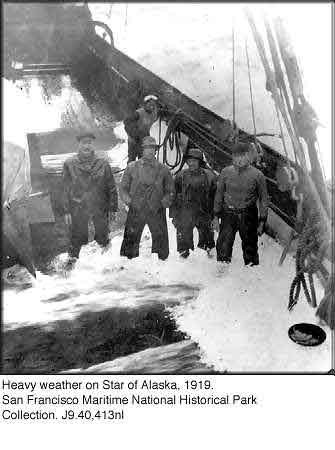
During this career, the ship sailed up the West Coast from Alameda, California, carrying supplies and cannery workers. Star of Alaska anchored out in Chignik Bay, Alaska, during April. After the supplies were unloaded and the cannery workers had settled into the company’s camp ashore, only a shipkeeper or two remained on board. In early September, her hold packed with cases of canned salmon, Star of Alaska started the 2,400-mile voyage back to San FranciscoBay. She was considered a fast sailer, averaging better than twenty-two days for the trip north and fifteen days when homeward bound. This photo, taken in 1919, shows a bit of heavy weather aboard Star of Alaska.
During the winter the ship was laid up with the rest of the Packer’s fleet of thirty-odd vessels in Alameda, where shipwrights performed maintenance and renovation. In 1911, the poop deck was extended to house Italian and Scandinavian fishermen. Later, additional bunks were added in the ‘tween deck for Chinese cannery workers. As Balclutha, the ship carried a crew of twenty-six men; on Star of Alaska, over 200 men made the trip north.
Star of Alaska was the only sailing ship the Packers sent north in 1930, and when she returned that September she, too, was retired.
Movie Star
Frank Kissinger purchased Star of Alaska in 1933 (for $5,000) and renamed her Pacific Queen. Kissinger took the ship south and, while anchored off Catalina Island, she appeared in the film Mutiny on the Bounty (Clark Gable and Charles Laughton also appeared in supporting roles). For a time thereafter, Kissinger towed her up and down the West Coast, usually exhibiting her as a "pirate ship." Pacific Queenslowly deteriorated, and she barely escaped World War II scrap metal drives.
Restoration
In 1954 the San Francisco Maritime Museum purchased Pacific Queen for $25,000. Assisted by donations of cash, materials and labor from the local community, the Museum restored the vessel and returned her original name. The ship was transferred to the National Park Service in 1978, and Balclutha was designated a National Historic Landmark in 1985.
|
|
|
The Balclutha
was built in
1886 by Charles
Connell & Co. Ltd.,
of
Glasgow in
Scotland, for
Robert McMillan, of
Dumbarton in
Scotland. Designed
as a general trader,
Balclutha
rounded
Cape Horn 17
times in 13 years.
During this period
she carried cargoes
such as wine, case
oil, and coal from
Europe and the
East Coast of the
United States to
various ports in the
Pacific. These
included
Chile for
nitrate,
Australia and
New Zealand for
wool,
Burma for rice,
San Francisco
for grain, and the
Pacific Northwest
for timber. In
1899 the
Balclutha
transferred to the
registry of
Hawaii, and
traded timber from
the Pacific
Northwest to
Australia, returning
to San Francisco
with Australian coal.
In
1902 the
Balclutha was
renamed the Star
of Alaska when
it was bought by the
Alaska Packers'
Association and
joined the
salmon fishing
trade, sailing north
from the San
Francisco area to
Alaska in April
with supplies,
fishermen and
cannery workers, and
returned in
September with
canned salmon. For
this trade she
carried over 200
crew and passengers,
as compared to the
26 man crew she
carried as the
Balclutha. Her
last voyage in this
trade was in
1930.
In
1933, the
Star of Alaska
was renamed the
Pacific Queen.
In this guise she
appeared in the film
Mutiny on the Bounty
starring
Clark Gable and
Charles Laughton.
She then eked out an
existence as an
exhibition ship,
gradually
deteriorating.
In
1954, the
Pacific Queen
was acquired by the
San Francisco
Maritime Museum, who
restored her and
renamed her back to
Balclutha. In
1985 she was
designated a
National Historic
Landmark. She is
now one of the
exhibits of the
San Francisco
Maritime National
Historical Park
and is to be found
moored at the park's
Hyde Street Pier.
As well as being
exhibited, she is
host to a monthly
sea shanty
sing-around
|
|
|
El Museo tiene tambien mas de 100
embarcaciones pequeñas, todas con algun significado historico, ademas
de la goleta C.A.Thayer, el Ferryboat Eureka y la barcaza/goleta de
carga Alma, que seran descriptas en un articulo en Histarmar. El
edificio principal del Museo, para mi mala suerte, estaba cerrado por
refacciones (abrira nuevamente en el 2009) y la bilbioteca tambien
estaba cerrada, pero los contactos los hice igual, aunque sin entrar!
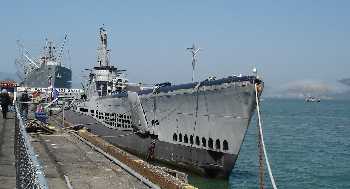
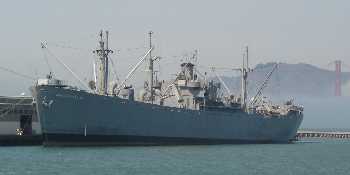
En un muelle vecino hay dos buques de la
segunda guerra mundial: El sumergible USS Pampanito, clase Balao, y
el Liberty "Jeremiah O´Brien".
El O´Brien con el Golden Gate y la eterna
niebla al fondo, y el Pampanito con Alcatraz detras, tambien medio
oculta por la niebla.
El Jeremiah O´Brien fue rescatado de la
flota de reserva en 1979 por
veteranos de la Marina Mercante y es el unico ejemplar de su clase
totalmente original, que esta operativo. Hace poco viajo a Normandia
para conmemorar el Desembarco del Dia "D". Todos sus elementos
funcionan, pero su mantenimiento cuesta mucho, por lo que las visitas
tambien son caras. El US Pampanito es un sumergible de Flota, clase
Balao, como tuvimos en la armada Argentina. Tuvo seis patrullas de
combate en el Pacifico, durante las cuales hundio seis buques por mas
de 27.000 tons. Ha sido restaurado a su configuracion original de la
2ª GM y es operado por la National Maritime Museum Association.
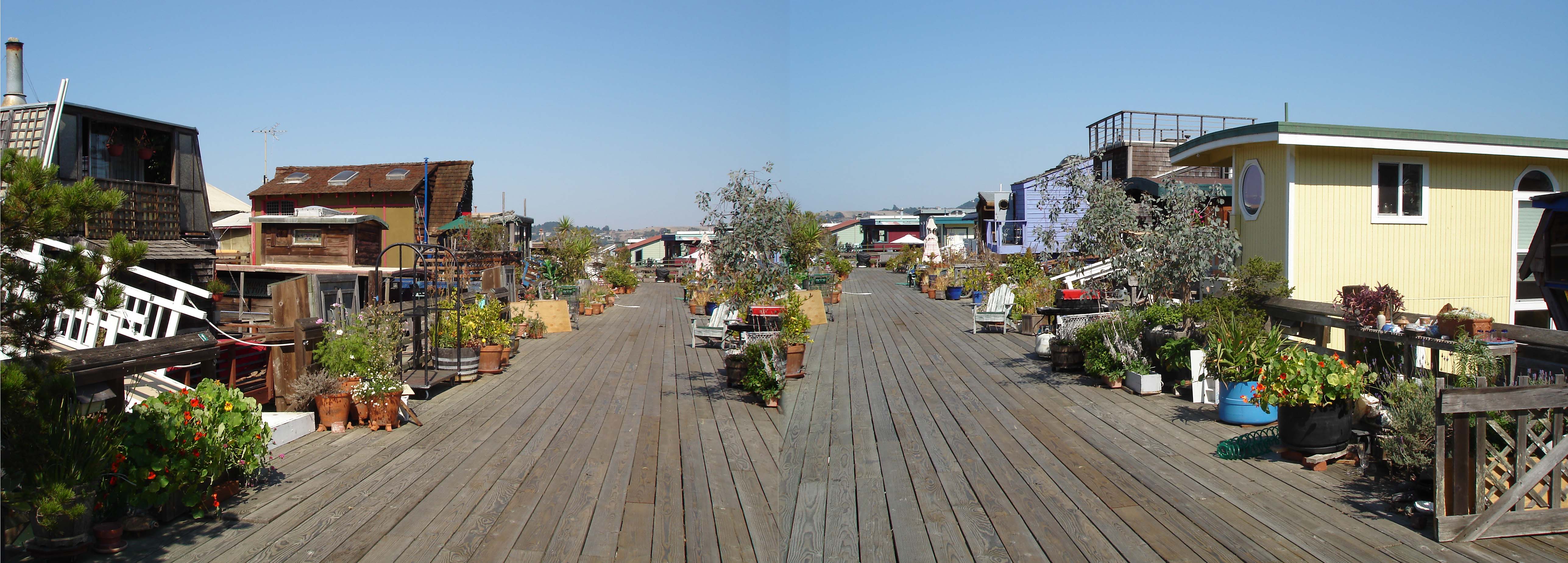
Una cosa curiosa en la Bahia de SF son
las casas flotantes, especificamente cruzando el Golden Gate, en
Sausalito. Por millas de costa hay muelles con casas flotantes, desde
verdaderas "villas de emergencia" hasta opulentas casonas señoriales,
con columnas y todo. Tienen todos los servicios, hasta jardines
privados, como se ve debajo.
Este "paseo" seguira por Monterey, San
Diego y Houston en sucesivos envios. Dado que no se puede incluir
mucho en este newsletter, los articulos de fondo estaran puestos en
Histarmar mas adelante.
|








;)
;)
;)
;)
;)
;)
;)