|
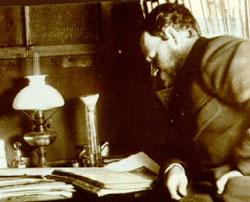
Dr. Otto Nordenskjöld, a Swedish geologist, led one of the most
fascinating and incredulous journeys ever attempted to the
Antarctic regions. The Germans, under the command of Erich von
Drygalski (the Gauss Expedition) and the British, under the
command of Robert Falcon Scott (the Discovery Expedition)
were in the final stages of their respective plans for research
south of the Pacific and Indian Oceans as the 32-year old
Nordenskjöld completed preparations for his expedition to the
southern reaches. Seven other scientists along with 16 officers
and men made the voyage south. The command was placed under an
experienced Antarctic explorer, Captain Carl Anton Larsen , who
had commanded the Jason during a whaling reconnaissance
mission in 1892-93 as far south as 64°40'S into the Weddell Sea.
A young geographer-geologist-anthropologist, named Dr. Gunnar
Andersson, was going to join the ship at the Falkland Islands and
assume leadership after Nordenskjöld's group was dropped off at
their wintering station. Plans then called for the Antarctic
and it's remaining crew to carry out research in the region during
the summer and fall before returning the following year to pick up
Nordenskjöld and his men. A good plan but one that went terribly
wrong.
The
Antarctic left Gothenburg on October 16, 1901 and arrived
at Buenos Aires on December 15. It was here that the expedition
was joined by an American artist, F. W. Stokes, and an Argentinean
naval officer, Lieutenant J. M. Sobral. The Argentinean government
offered Nordenskjöld free food, fuel and help if their officer
could join the wintering party...an offer too good to refuse. The
ship left for the southern latitudes on December 21 and arrived in
the South Shetlands on January 11, 1902. They landed, spending a
short time on one of the islands, and then proceeded on south to
explore the Orléans Strait. Nordenskjöld wrote in his diary,
"We were now sailing a sea across which none had hitherto
voyaged. The weather had changed as if by magic; it seemed as
though the Antarctic world repented of the inhospitable way in
which it had received us the previous day, or, maybe, it merely
wished to entice us deeper into its interior in order the more
surely to annihilate us. At all events, we pressed onward, seized
by that almost feverish eagerness which can only be felt by an
explorer who stands upon the threshold of the great unknown".
Soon
Nordenskjöld made what he considered to be his most important
geographical discovery of the expedition: contrary to popular
belief, they soon saw that Louis-Philippe Land was connected to
Danco Land and that the Orléans Strait ran into Gerlache Strait.
He wanted to continue on but time was short so they turned around
and headed back until the sound between Louis-Philippe Land and
Joinville Island was reached. French explorer Dumont d'Urville
originally discovered the sound but since no ship had ever sailed
through, he named it after the Antarctic. Once they made it
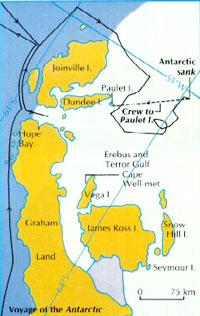
across the sound, they landed on Paulet Island and from there
crossed Erebus and Terror Gulf and made a depot on Seymour Island.
The ship then steamed southwest towards the unexplored region of
eastern Oscar II Land Coast. They made it as far as 60°10'S
before running into a line of ice. They followed it eastwards
until reaching 63°30'S, 45°7'W on February 1 at which time the
ship was forced to turn back. By February 9 they spotted land
again and for his winter campsite Nordenskjöld chose Snow Hill
Island, southwest of Seymour Island. He and five others were put
ashore with equipment, supplies and sledge dogs after which the Antarctic
headed north for the Falklands.
The
first project the men completed was a small magnetic observatory
which served as shelter until the prefabricated hut could be
built. A group of strong storms rocked the camp which gave them an
idea of what was to come. By the beginning of March the weather
had started to improve. Nordenskjöld made a number of trips by
boat and dog sledge to establish depots. When spring arrived,
Nordenskjöld, Sobral and seaman Jonassen set off for the eastern
part of Oscar II Coast again with the men towing one sledge and
the dogs the other. On a good day they could travel 30 miles but
this was the exception as the terrain was filled with crevasses,
one of which nearly cost Nordenskjöld his life. They finally
reached their goal as Nordenskjöld wrote, "We did not make
much ado about choosing our camping-ground (October 18) but
pitched our tent on the ice at the foot of a projecting, brown,
weather-worn, rocky headland, torn by the frost into a mass of
mighty blocks. The reader can easily imagine with what feelings I
hurried forward to these rocks, the first spot trodden by human
foot on the whole of the eastern coast of the mainland of West
Antarctica". Bad weather hounded them, Jonassen hurt his arm,
the tent was torn to shreds in a storm and the dogs found their
sack of food which they promptly ate, consuming it all along with
part of the sack, some harness and the whip; it was time to go
home. The three men made it back to winter quarters on October 31
having covered 380 miles in 33 days.
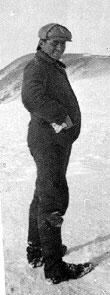
Lieutenant José Sobral
 By the end of November the sea ice
had still not broken up. In early December Nordenskjöld made a
sledge journey to Seymour Island and made some important fossil
discoveries but heavy on his mind was the fact that the sea ice
was not breaking up and the ship was no where in sight. The ship
had been expected any day in January and February yet still she
didn't show up and their fate was sealed on February 18 when a
storm came in from the south and froze the sea completely over.
The men were depressed, to say the least, at the prospects of
spending another cold winter in the damp, cramped winter quarters
on Snow Hill Island.
By the end of November the sea ice
had still not broken up. In early December Nordenskjöld made a
sledge journey to Seymour Island and made some important fossil
discoveries but heavy on his mind was the fact that the sea ice
was not breaking up and the ship was no where in sight. The ship
had been expected any day in January and February yet still she
didn't show up and their fate was sealed on February 18 when a
storm came in from the south and froze the sea completely over.
The men were depressed, to say the least, at the prospects of
spending another cold winter in the damp, cramped winter quarters
on Snow Hill Island.
When
spring arrived, Nordenskjöld and Jonassen set off on another
sledge trip, this time to discover whether the huge gulf they had
found the previous year behind Cape Foster connected with the bay
north of Cape Gordon. Good weather allowed them, within five days
on the ice, to determine this to be true and they named the
stretch of water the Crown Prince Gustav Channel. The men now made
for a peak on Vega Island in order to get a better glimpse at the
ice conditions in Erebus and Terror Gulf as they wanted to cross
over to Paulet Island. As they approached the land, Jonassen
spotted what he believed to be penguins. He took out his field
glasses and was astonished to see that it was actually three men!
When they met, Nordenskjöld described the three as "black as
soot from top to toe; men with black clothes, black faces and high
black caps, and with their eyes hidden by peculiar wooden
frames...my powers of guessing fail me when I endeavour to imagine
to what race of men these creatures belong". When they told
him who they were he still didn't recognize them. They were Gunnar
Andersson, Lieutenant Duse and Toralf Grunden and their story was
incredible.
The
Sinking of the Antarctic
The
Antarctic headed back to the Falklands after dropping
Nordenskjöld and his party off at Snow Hill Island. They spent
the winter of 1902 there and picked up Gunnar Andersson. They left
the Falklands on November 5, 1902 for the return trip to pick up
the wintering party. The first sign of trouble came on November 9,
at a latitude of only 59°30'S, when pack ice was encountered.
Within two days the ship was held tight. Carl Larsen was able to
ram his way forward but on November 17 a storm hit that put the Antarctic
in jeopardy as Andersson wrote, "At 2:30 am on 21 November I
was awakened by loud orders from the captain's bridge, and I
dressed myself hurriedly and hastened on deck. Three or four
ship's lengths on our larboard lay an iceberg which was
considerably higher than our mainmast and about three times as
long as the vessel...We were in evident danger of being carried by
the pack which lay close around the Antarctic, right on to
the ice-mountain. To add to our difficulties we were in the midst
of a blinding snowstorm. The engines were going full speed, and we
had the jib and fore-sail set. For a long time the vessel moved
slowly forward a few yards, only to be pressed back by the floes,
but after a while the pieces of ice gave way before the united
pressure of steam and sail, and the Antarctic glided past
the iceberg into the lead which had been formed in its lee".
When the storm let up, the ship was able to move into open waters
around the South Shetlands and eventually make landfall at
Deception Island. After leaving Deception Island efforts were
focused on an attempt to correctly chart the Orléans and Gerlache
Straits since the Belgica Expedition, led by Adrien de
Gerlache in 1898, had failed to do so. The charting was completed
on December 5 and the Antarctic then steamed for Antarctic
Sound which would lead them to Nordenskjöld's winter quarters.
Unfortunately, as the ship approached the sound, the lead between
the ice became narrower and narrower and by the time the ship
reached the vicinity of Mount Bransfield, the way was completely
blocked. Andersson went ashore at Louis-Philippe Land in order to
get a better look at the ice in the sound. Andersson reported back
that Erebus and Terror Gulf was a complete sheet of ice but Larsen
decided to try and ram his way through anyway. Many days later
found them no better off. Larsen gave up on his idea and decided
they would try to reach Nordenskjöld by sledge party. The ship
finally broke free from the pack ice and Larsen headed once more
for Antarctic Sound. On December 29 Andersson, Duse and Toralf
Grunden were put ashore at Hope Bay. The men immediately
established a depot for the wintering party in case the ship was
not able to reach the winter quarters. They then set off on the
200-mile journey to Snow Hill Island. Larsen and the rest of the
men on the Antarctic tried again to make their way to the
southeast. She was still caught in the pack ice as a fierce storm
blew her southwards... first bow first, then sideways, then stern
first. This event continued until they reached the vicinity of
Paulet Island. In his diary on January 10, 1903, scientist Carl
Skottsberg wrote, "During the afternoon the pressure on the
sides of the vessel--which had begun yesterday--could scarcely be
marked, but after dinner, just as we sat down to a hand at cards,
the ship began to tremble like an aspen leaf, and a violent crash
sent us all up on deck to see what the matter was. The pressure
was tremendous; the vessel rose higher and higher, while the ice
was crushed to powder along her sides". The ship was able to
rise above the pressure of the ice but later that night the Antarctic
began to list to starboard. Everyone prepared to abandon ship but
fortunately the pumps were able to keep up with the leak. Nearly
two weeks went by like this as the ship drifted southeastwards in
the ice. On January 16 the ice opened up to the point where the
ship was able to right herself and on February 3 the pressure from
an ice floe at her bow shook the stern loose and for the first
time in weeks she was afloat. Unfortunately, this only worsened
the leak so in an act of desperation, Larsen decided to try and
beach the ship on Paulet Island. By February 12 the ship had
managed to drift into a large lead that had opened in the
direction of Paulet Island. The engine was started and the sails
hoisted in a furious attempt to reach the island. But, this only
made the leak unmanageable and, as the water rose, the order was
given to abandon ship. "We stand in a long row on the edge of
the ice", wrote Skottsberg, "and cannot take our eyes
off her...The pumps are still going, but the sound grows fainter
and fainter...she is breathing her last. She sinks slowly deeper
and deeper...Now the name disappears from sight. Now the water is
up to the rail, and with a rattle, the sea and bits of ice rush in
over her deck. That sound I can never forget, however long I may
live. Now the blue and yellow colours are drawn down into the
deep. The mizzen-mast strikes against the edge of our floe and is
snapped off; the main-mast strikes and breaks; the crow's nest
rattles against the ice-edge, and the streamer, with the name Antarctic
disappears in the waves. The bowsprit--the last mast-top---She is
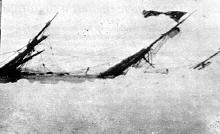
gone!" The Antarctic sank 25 miles from Paulet Island
and the shipwrecked party now began the nightmare journey to it
across the ice.
 What supplies could be saved were
loaded onto the whale boat and ferried from ice floe to ice floe.
They were in constant danger from icebergs threatening their
campsites on the ice but after 14 days and a six-hour row, they
finally struggled ashore on Paulet Island on February 28, 1903.
The only hope the men had was that Andersson was able to make
arrangements for a rescue party if the Antarctic had not
returned by autumn. Even if this were accomplished the men knew
they would be in for a very difficult winter ahead as there would
simply be no possibility of a rescue ship making it through the
sea ice this late in the season.
What supplies could be saved were
loaded onto the whale boat and ferried from ice floe to ice floe.
They were in constant danger from icebergs threatening their
campsites on the ice but after 14 days and a six-hour row, they
finally struggled ashore on Paulet Island on February 28, 1903.
The only hope the men had was that Andersson was able to make
arrangements for a rescue party if the Antarctic had not
returned by autumn. Even if this were accomplished the men knew
they would be in for a very difficult winter ahead as there would
simply be no possibility of a rescue ship making it through the
sea ice this late in the season.
While
the Antarctic was trying to find a route to pick up
Nordenskjöld and the others, Gunnar Andersson, Lt. Duse and
Toralf Grunden's attempt to reach the winter quarters on foot was
being compromised by their lack of knowledge of the geography of
the area. After being put ashore, the men headed off in a
south-southwesterly direction which, according to James Clark
Ross's chart, would bring them to Sidney Herbert Sound.
Unfortunately, instead of finding a continuation of land after
their struggle across the eastern end of Louis-Philippe Land they
found themselves at the frozen entrance of the Crown Prince Gustav
Channel. Andersson wrote, "We stand silent and perplexed and
gaze at the new and wonderful scene. Mile upon mile of snowy
plain, such as we have never seen before, meets our eyes. One can
actually imagine that a gigantic snow-clad city lies before us,
with houses, and palaces in thousands, and in hundreds of
changing, irregular forms--towers and spires, and all the wonders
of the world. At first sight it appears incomprehensible, but it
must be, after all, a bay covered with a frozen-in mass of
numberless icebergs". The men set off across the bay on skis
for Vega Island and, after 15 hours, reached the island and set up
camp. The men thought for certain they were on James Ross Island
and therefore would soon be able to reach Admiralty Sound. They
climbed a peak on the island and to their dismay discovered their
way blocked by an expanse of open water which they immediately
recognized as Sidney Herbert Sound. But....they could see open
water to the south so they assumed the Antarctic had
experienced little difficulty reaching the winter quarters on Snow
Hill Island that summer. This final reasoning sealed their fate
for the coming winter. Before Larsen dropped Andersson and the
other two men off at Hope Bay, plans had been made between them
that entailed the following: whoever was the first to arrive at
winter quarters on Snow Hill Island was to gather the winter party
and make for a rendezvous with the trailing group back at Hope
Bay. After seeing all the open water to the south of them,
Andersson and his men took it for granted that the Antarctic
had already arrived at Snow Hill Island and were proceeding to
Hope Bay to pick them up. They gave it no further thought and were
back at their depot at Hope Bay on January 13 where they settled
down to await arrival of the ship to pick them up.
 But, those days turned into weeks
and it finally occurred to them that something had gone terribly
wrong. On February 11 they started building a winter hut made with
stone walls to a height of the tallest man. The sledge, turned
upside down, served as the roof which was then covered with some
planks and an old tarp. Inside the structure they put up the tent
in order to give them some extra added protection. The floor was
covered with penguin skins and on March 11 the hut was ready for
occupancy. As winter set in, the snow surrounding them kept the
inside temperature to a comfortable few degrees below
freezing...any warmer would melt the ice on the walls and ceiling.
The three men hunted penguins to supplement their food resources
and eventually killed 700 of them. They even managed to kill a few
seals and catch some fish through holes in the ice. They each took
turn on duty and entertaining one another in the evenings.
According to Andersson, the winter passed quickly. When spring
arrived, Andersson made a short trek to see if the channel up to
Vega Island was frozen and indeed it was. The men thankfully
departed their hut on September 29 in search of the others. All of
them were a fit to see as they were blackened by soot from head to
foot with long scraggy beards and dirty, ragged clothes. They had
just started their journey when a storm came up, trapping them in
their small tent. Andersson wrote, "The storm grew more and
more violent while the cold increased in intensity, and during the
following night the tent-wall fell on my head and the snow packed
itself over me, so that I lay fast as though in a vice. I was not
released from my position until the storm had subsided, some 30
hours later". They reached Vega Island on October 9 and found
the depot left the previous summer. The next two days were spent
taking care of Grunden's and Duse's frostbite. After further
exploration they were able to confirm that Sidney Herbert Sound
actually connected with Crown Prince Gustav Channel but any decent
from the island would be extremely difficult. Therefore, the men
retraced their steps and began the last leg of their journey to
meet up with the others by way of the sea ice around the island.
They reached Cape Dreyfus, soon renamed Cape Well-met, on October
12. Andersson wrote, "At 1 PM we had halted at the cape in
order to prepare dinner. Groups of seals lay here and there upon
the ice; we had just passed by a couple of the animals, and a
large family lay some distance further out. 'What the deuce can
those seals be, standing up there bolt upright?' says one of us,
pointing to some small, dark objects far away on the ice, in
towards the channel. 'They are moving', cries another. A delirious
eagerness seizes us. A field-glass is pulled out. 'It's men!
It's men!' we shout". At long last the men were reunited
with their leader.
But, those days turned into weeks
and it finally occurred to them that something had gone terribly
wrong. On February 11 they started building a winter hut made with
stone walls to a height of the tallest man. The sledge, turned
upside down, served as the roof which was then covered with some
planks and an old tarp. Inside the structure they put up the tent
in order to give them some extra added protection. The floor was
covered with penguin skins and on March 11 the hut was ready for
occupancy. As winter set in, the snow surrounding them kept the
inside temperature to a comfortable few degrees below
freezing...any warmer would melt the ice on the walls and ceiling.
The three men hunted penguins to supplement their food resources
and eventually killed 700 of them. They even managed to kill a few
seals and catch some fish through holes in the ice. They each took
turn on duty and entertaining one another in the evenings.
According to Andersson, the winter passed quickly. When spring
arrived, Andersson made a short trek to see if the channel up to
Vega Island was frozen and indeed it was. The men thankfully
departed their hut on September 29 in search of the others. All of
them were a fit to see as they were blackened by soot from head to
foot with long scraggy beards and dirty, ragged clothes. They had
just started their journey when a storm came up, trapping them in
their small tent. Andersson wrote, "The storm grew more and
more violent while the cold increased in intensity, and during the
following night the tent-wall fell on my head and the snow packed
itself over me, so that I lay fast as though in a vice. I was not
released from my position until the storm had subsided, some 30
hours later". They reached Vega Island on October 9 and found
the depot left the previous summer. The next two days were spent
taking care of Grunden's and Duse's frostbite. After further
exploration they were able to confirm that Sidney Herbert Sound
actually connected with Crown Prince Gustav Channel but any decent
from the island would be extremely difficult. Therefore, the men
retraced their steps and began the last leg of their journey to
meet up with the others by way of the sea ice around the island.
They reached Cape Dreyfus, soon renamed Cape Well-met, on October
12. Andersson wrote, "At 1 PM we had halted at the cape in
order to prepare dinner. Groups of seals lay here and there upon
the ice; we had just passed by a couple of the animals, and a
large family lay some distance further out. 'What the deuce can
those seals be, standing up there bolt upright?' says one of us,
pointing to some small, dark objects far away on the ice, in
towards the channel. 'They are moving', cries another. A delirious
eagerness seizes us. A field-glass is pulled out. 'It's men!
It's men!' we shout". At long last the men were reunited
with their leader.
The
Rescue
The
story of Captain Larsen and the stranded men from the Antarctic
is another story of incredible courage. They had existed in a
makeshift hut on Paulet Island throughout the long winter months
of 1903. The marooned men spent their first full day ashore on
Paulet Island on March 1, hunting penguins and seals to supplement
their food supplies for the coming winter. By the end, 1100
penguins had been killed. Work was also started on a stone hut
which was not a job for the weak at heart. Stones had to be
gathered and carried long distances to the site where the
double-walled structure was built. When it was finished, it
measured 34 feet by 22 feet with most of it taken up by the living
quarters; twelve feet was used for the kitchen. Two stone beds
were built along the walls of the living area, each measuring
seven feet wide and accommodating 10 men each. By mid March,
storms were quite violent and soon one of them blew the kitchen
roof off. The winter days dragged on as the cycle continued:
sleeping, cooking penguin (and occasional seal or fish), hunting
and evenings spent talking or reading out loud from one of the few
books that survived the sinking of the Antarctic. From time
to time they would have a sing-along but the men acutely feared
what their final outcome would be. Skottsberg wrote, "Many
hundred dreams have been dreamed in our island but I do not know
if they helped to brighten our existence. They grouped themselves
around two objects--food and rescue. Why, we could dream through a
whole dinner, from the soup to the dessert, and waken to be
cruelly disappointed. How many times did one not see the relief
vessel in our visions--sometimes as a large ship, sometimes as
nothing but a little sloop? And we knew the persons on board; they
spoke about our journey; took us in their arms; patted us on the
back...". But the reality of the situation was far different
as food supplies dwindled away. On June 7, Ole Wennersgaard died.
They buried him in a snowdrift until they could properly bury him
in the spring.
The
months dragged on until October arrived along with a breakup of
the sea ice in the gulf which was a clear indication that the sea
was clear for a ship to try and reach the three men they had left
at Hope Bay. Carl Larsen took five crewmembers from the Antarctic
and headed off for Hope Bay at dawn on October 31 in hopes of
contacting a rescue ship. They fought the weather all the way but
on November 4 they finally reached Hope Bay. To their dismay they
found the depot and stone hut but no sign of the men. Attached to
the hut was a board on which a note had been written informing
anyone who found it that Gunnar Andersson, Lieutenant Duse and
Toralf Grunden had wintered there. A sketched map was found in a
flask that showed Larsen the route the three men were taking in
their attempt to reach Snow Hill Island. Larsen realized he would
have to make the same journey but for him it would be by water.
Bad weather delayed them for three days before they were able to
launch their small boat into Antarctic Sound. Larsen wrote,
"We broke up at 4 am and then rowed the whole day in the
direction of Sidney Herbert Bay. Only here and there did we meet
with scattered ice. The fine weather continued the whole of the
next night, and we were making rapid progress towards our goal
when, just as we passed Cape Gage and came into Admiralty Sound we
met with a hinder which could not be forced by the boat. We found
the ice extending in a straight line right over the bay towards
Cockburn Island and Cape Seymour, and inwards across the whole of
the sound. So at 2 am we drew the boat up on the ice and retired
to rest". As Larsen and his companions struggled across the
gulf, close by was a rescue ship working it's way through the ice
around Joinville Island. The folks back in Sweden and Argentina
had become very concerned with the fate of the Antarctic
when she didn't return. After all, both the British (Discovery)
and German (Gauss) expeditions had barely escaped the
unusual ice conditions that summer. So, arrangements were made for
France, Sweden and Argentina to send rescue ships to the vicinity
of Snow Hill Island the following spring. Lieutenant Julian
Irizar, the Argentinian naval attaché in London, was chosen to
lead the Argentinean rescue expedition aboard the corvette Uruguay.
Meanwhile, as rescue preparations were being made, Nordenskjöld
returned to Hope Bay along with Andersson, Duse and Toralf. On
October 26, Nordenskjöld, Andersson and Sobral undertook a
journey to Seymour Island and left an inscribed message on a
boathook which was raised as a signal on a cairn of rocks.
November 7 became a day of great excitement: on this day Larsen
and his men began their epic row across Erebus and Terror Gulf; as
they were doing this, two more members of the wintering party, Gösta
Bodman and Gustaf Akerlund, left winter quarters for Seymour
Island; and finally it was on this date that Lieutenant Irizar and
the Uruguay reached the ice shelf off Seymour Island. A
small party of men were put ashore to explore the region and that
very afternoon discovered the boathook previously planted by
Andersson and Sobral. Irizar slowly inched his ship along the edge
of the ice until a tent was visible on the shore. Irizar and
Lieutenant Yalour landed, walked to the tent and proceeded to wake
up the two men inside--Bodman and Akerlund. The two officers then
followed the Swedes across the ice to the winter quarters.
Nordenskjöld may have been consumed with delight but this was
quickly tempered when the Argentineans informed him that they had
not seen any sign of the Antarctic. They quickly agreed to
abandon the camp so that the search for the missing ship could
start. All of a sudden the dogs started barking and when they went
outside, to their astonishment was Bodman greeting Larsen and his
party who had just completed the 15-mile journey across the ice.
Nordenskjöld wrote, "No pen can describe the boundless joy
of this first moment...I learned at once that our dear old ship
was no more in existence, but for the instant I could feel nothing
but joy when I saw amongst us these men, on whom I had only a few
minutes before been thinking with feelings of the greatest
despondency". All the men had finally been reunited.
The
Hut at Winter Quarters
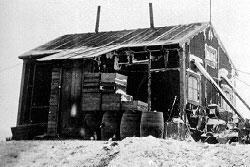
Otto
Nordenskjöld's uncle was the discoverer of the Northeast Passage
around Siberia. Nordenskjöld held a doctorate in geology and
lectured at Uppsala University. He led geological expeditions to
Tierra del Fuego in 1895-97 and to the Yukon in 1898. Upon return
from the Antarctic Expedition, Nordenskjöld received much
fame but remained in debt for the rest of his life. Nevertheless,
he led further expeditions to Greenland in 1909 and to Peru and
southern Chile in 1920-21.
|